By Kristen Neymarc
At a recent town hall in Chatham Borough, Rep. Analilia Mejia (D-11th Dist.) emphasized her four months in Congress rather than her campaign to stay on Capitol Hill. She did not mention Donald Trump, socialism or even the Nov. 3 election, focusing instead on the work of her office and the concerns residents brought with them.
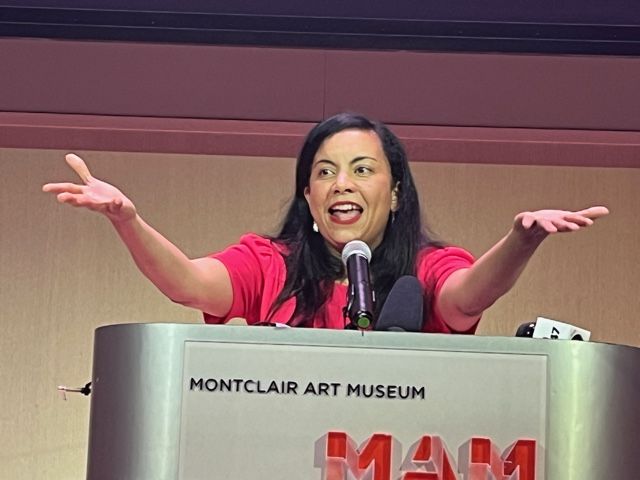
“I’m new to this. It’s only been four months,” Rep. Analilia Mejia told constituents gathered at the Stanley Center in Chatham Borough on Sept. 30. “I mostly want to hear from you,” she told the audience.
Mejia and Joe Hathaway will face each other again Nov. 3, this time for a full two-year term. In their April 16 special-election matchup, Mejia won by about 20 percentage points, taking roughly 60 percent of the vote to Hathaway’s 40 percent, and succeeded former Rep. Mikie Sherrill. NJ-11 includes parts of Morris, Passaic and Essex counties.
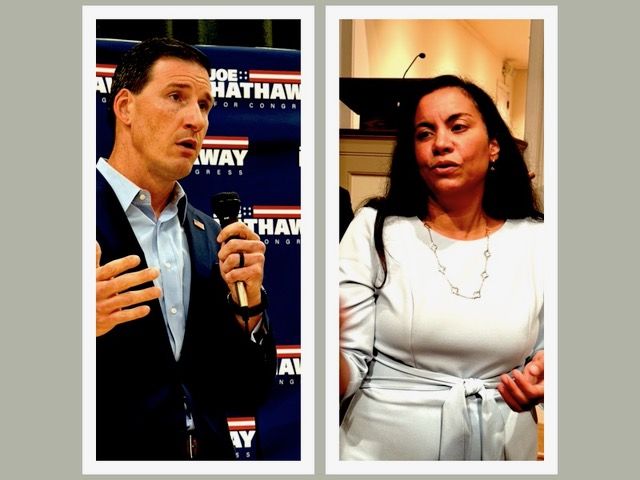
The candidates will square off for their first — and likely only — debate of the rematch this evening, Monday, Oct. 26, 2026, at 6:30 pm at St. Elizabeth University in Morris Township. The event also will be livestreamed by the League of Women Voters of the Morris Area.
In addition to her brief incumbency, Mejia holds another advantage over her opponent as the election enters the home stretch: Money.
Filings with the Federal Election Commission show she has raised more than $2.2 million and spent about $2.1 million. Hathaway has raised about $840,000 and spent almost $800,000. Almost 80 percent of Mejia’s support is from individual donors; progressive political groups and labor unions also are contributors.
At the Chatham event, voting rights quickly emerged as one of the larger concerns, along with immigration, health care, artificial intelligence and the local impact of data centers. Residents wanted to know whether their mail ballots were safe and what they could do themselves to protect elections in an atmosphere some described as increasingly uncertain.
Mejia brought two specialists with her: DaWuan Norwood, policy counsel at the ACLU of New Jersey and a voting-rights attorney, and Jennifer Danis, federal energy policy director at the Institute for Policy Integrity at NYU School of Law.
She also explained that she might not always have an answer on the spot to all questions. “No questions get left unanswered, but I do believe in accuracy,” Mejia said. When an answer required more work, staff members took contact information for follow-up.
INSIDE DELANEY HALL
Before opening the floor, Mejia talked about some of the work she has taken on as a member of the House Homeland Security and Small Business committees.
Much of that discussion centered on Delaney Hall, the federal immigration detention facility in Newark that Mejia has visited repeatedly. She said members of Congress had organized their visits so that at least one member was going there every week.
“What we are seeing is our government, in many ways, weakening due process and equal protection,” she said.
Mejia described people she said had been working through the immigration system and then found themselves detained. One was a woman from the district who owned a business with her husband and had diabetes. When Mejia visited her, she said, the woman looked ill. Mejia later learned she was receiving a quarter of her prescribed metformin.
“Anyone that’s diabetic or has cared for a diabetic understands how horrible that is,” Mejia said. “That is a slow death.”She said she had heard similar complaints from other detainees about medication and medical care.
At the same time, Mejia said she was not arguing that immigration laws should go unenforced. “We can and should uphold our borders,” she said. “We should absolutely fix our broken immigration system.”
Her concern, she said, was what happens once people are in government custody and what she sees as an erosion of protections that extend beyond the immigration debate.”If we allow that to be eroded for anyone, we are de facto allowing it to be eroded for all.”
For now, Mejia described part of her role at Delaney Hall as “bearing witness, gathering information” and putting what she learns into the public record.
HELP WITH FEDERAL AGENCY ISSUES
The town hall also gave Mejia a chance to explain a less visible part of congressional work: Helping constituents when something has gone wrong with a federal agency.
She called on Willie Tolba, her constituent service manager, who said the office deals with problems involving Social Security and Medicare, veterans’ benefits, the IRS, immigration petitions and passports. Sometimes, he said, the problem is as immediate as a family discovering just before an international trip that a child’s passport has expired.
“Honestly, call us,” Tolba said. The office cannot promise to solve every problem, he said, but it can contact federal agencies, seek clarification and try to get a constituent to the right place when the issue belongs elsewhere.
Tolba also explained the congressional nomination process for students applying to U.S. military service academies.
WORRIES ABOUT VOTING
Once questions began, voting came up almost immediately.
One resident said she had received her vote-by-mail ballot and planned to use a local drop box, but wondered whether mail voting was safe.
Norwood said voting early — which began over the weekend — voting by mail and voting on Election Day were all safe and secure. For someone using a mail ballot, he recommended returning it to a drop box.
Another resident asked what individuals themselves could do to protect the integrity of elections this year and heading into 2028.
“Education, education, education,” Norwood said. He urged people to know their voting rights before Election Day, find out what protections local election officials have in place and know where to turn if something goes wrong at the polls. He pointed residents to the national Election Protection hotline (866-687-8683), for problems encountered while voting.
AI, FROM MISINFORMATION TO DATA CENTERS
Mejia said she supports stronger federal regulation of AI and had joined Sen. Bernie Sanders and Rep. Greg Casar in supporting a ban on artificial superintelligence.
“I’m not a luddite, okay,” she said, “but I think that we need to have guardrails in the development of this technology.” She compared AI to industries such as air travel and the pharmaceutical industry that already face federal safety regulation and suggested creating an independent agency, similar to the FDA, that would be advised by experts and able to stop the release of technologies considered dangerous.
Then the conversation shifted from AI itself to the physical infrastructure needed to support it.
Mejia said she supports a pause on new AI data-center development while protections are put in place for local power grids, water supplies and consumers. “This is a pause. This isn’t a permanent stop,” she said.
Danis took up the more technical questions about what data centers can mean for communities, including their demands on electricity and water and who ultimately pays for new infrastructure.
Residents wanted to know what would happen if a neighboring town approved a large data center even if Chatham itself did not. Water and electric systems, they pointed out, do not stop at municipal borders. Danis responded municipalities and states have some authority through land-use and infrastructure decisions and questions involving the electric grid can cross state and federal lines.
For Mejia, the question of who should pay was less complicated. “They should be responsible for that cost,” she said of data-center operators. “It shouldn’t be transferred to ratepayers like ourselves.”
The questions kept coming until staff began warning that time was running short. There were still many more hands in the air.
Correspondent Sophia Ricciardelli contributed to this report.
MORE ON MEJIA-HATHAWAY 2026 CAMPAIGNS
Morristown has a long history of people stepping forward in pivotal moments.
When you chip in to Morristown Green, you’re helping your neighbors stay informed, strengthening our civic backbone, and carrying on the spirit that’s defined this town since its earliest days.
Rally for local news.