


By Jeffrey V. Moy, North Jersey History and Genealogy Center
This year marks the 50th anniversary of the first LGBT Pride march held in New York City, on June 28, 1970, one year after the Stonewall Riots that were precipitated by years of anti-gay persecution and harassment.
Organizers sought to end laws making it illegal for gay and lesbian Americans to congregate in bars, and end the subsequent police raids that resulted in arrests while also ending careers and families.
Over the following five decades, New Jerseyans came out to build new relationships with neighbors, co-workers, and family, and sought legislative means to end workplace and housing discrimination — while also living busy lives of their own.

During the aftermath of Stonewall, Gay Activist Alliance groups started in several states. New York City’s Alliance was one of the region’s most prominent, and its members worked to focus media attention on those suppressing lesbian, gay, bisexual, and transgender (LGBT) rights. It was most active from 1969 until its headquarters was destroyed by arson in 1974.

The Gay Activist Alliance in Morris County (GAAMC) was founded in 1972 by Jenny Glaab, Jeff Samuels, John Sheehey III, and Mickey Suiter, all of whom were between 18 and 21 years old.
Headquartered at Morristown’s Unitarian Fellowship Church, GAAMC membership quickly grew from 25 to 100 by 1976, and by the late 1970s members were instrumental in confronting new and existing discriminatory laws, while also providing support services and social activities for residents.

GAAMC coordinated statewide events with the New Jersey Lesbian and Gay Coalition from the early 1970s, fought legislation aimed at re-criminalizing homosexuality in New Jersey, established a speakers series and the nation’s first Gay Blood Blank, organized camping and ski trips, and held protests to hold hands across the George Washington Bridge and around the Statue of Liberty.

Beginning in 1977, GAAMC members staffed a resource hotline for anyone in the state who needed information on a range of LGBT topics, including issues around coming out, locating social groups and bars, and finding doctors, attorneys and other businesses that served LGBT customers.
By 1992, the Gay Helpline of New Jersey was staffed by two volunteers from 7:30-10:30 pm seven days a week, who responded to over 3,000 calls per year, and returned thousands more answering machine messages.
Meanwhile, businesses and professionals advertised in GAAMC newsletters and neighborhood guides to let readers know that they welcomed LGBT customers.

GAAMC membership continued to grow into the 1980s, and by 1984 its Celebration event, which was held the week before New York City’s Pride March, attracted over 1,100 from across New Jersey, upstate New York, Pennsylvania, and Long Island.
Individuals also founded the Gay and Lesbian Youth in New Jersey (GAYLY-NJ) in 1989 for young people to network and socialize with each other. Outreach efforts by the 1990s extended to distributing Challenge newsletters to members and GAAMC brochures to bars and library reference desks, in addition to Helpline cards.

In 1978, a New Jersey state senator sought to re-criminalize gay and lesbian acts between consenting adults with Senate bill 1276, which threatened penalties of five to 10 years imprisonment and/or a $7,500 fine, while exempting straight couples committing the same acts.
GAAMC and a coalition of gay and straight organizations across the state mobilized against the law and elicited 15,000 letters of opposition; the sponsor failed to gain support and withdrew the bill.
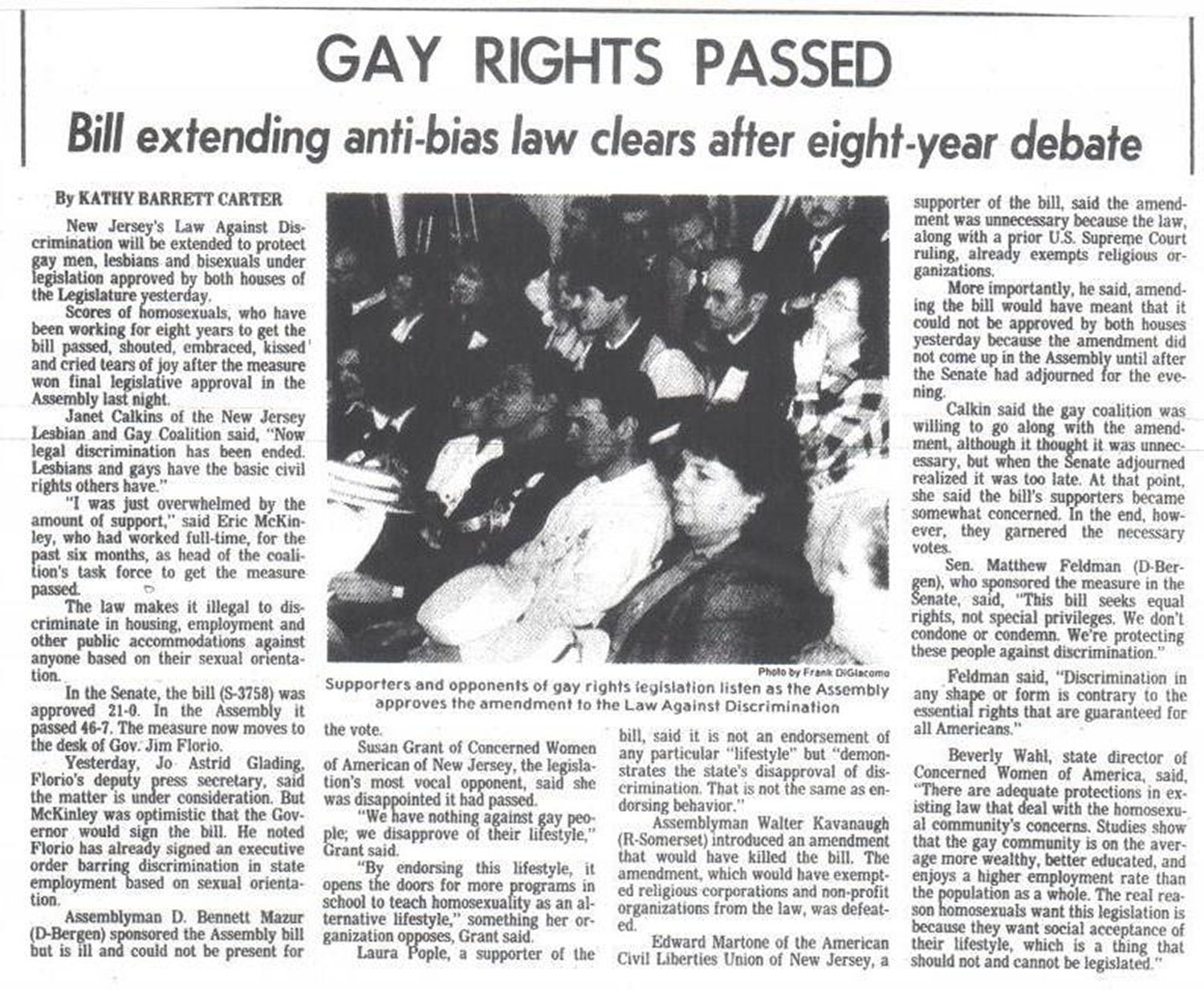
Members of the Lesbian and Gay Coalition worked to win passage of legislation in 1992 to include sexual orientation in New Jersey’s anti-discrimination law.
Senate bill 3758 made it illegal in New Jersey “to discriminate in housing, employment, and other public accommodations against anyone based on their sexual orientation,” extending basic civil rights previously offered to Americans regardless of race, religion, country of origin, or sex that was included in the 1964 Civil Rights Act.
The state Senate approved the bill 21-0 and it passed the Assembly 46-7.

While some New Jerseyans fought to pass civil rights laws, others just wanted a place to have a drink and meet up with friends, which they found at Maddie’s Mine Hill Tavern.
By the late 1960s, the small working class bar frequented by iron miners and hunters attracted a growing number of LGBT customers from across northern and central New Jersey, and as far away as New York City, including young adults, corporate professionals, suburban homeowners, those who came out late in life, while continuing to serve many straight men and women.

While many Morris County residents made good lives for themselves, finding welcoming neighborhoods was not a given. Nevertheless, David Morris recounted the everyday problems of a homeowner in a 1997 Daily Record article.
“When I owned a home, crabgrass did not escape my lawn because I was gay,” Morris said.
“We are concerned with the same things as pretty much everyone else. We are concerned with deer eating our expensive shrubbery. I’m interested in a good school system. I don’t have a child but I didn’t mind paying taxes when I owned a house because I believed the children deserve good schools, and I had to bear my share of the burden.”
Other individuals still faced discrimination in the workplace, in schools, and on the street where couples constantly evaluated where it was safe to hold hands. One GAAMC member recalled in a 1992 Daily Record interview several instances of anonymous threats made to her work phone because she refused to lie about her partner’s identity. Yet overall, she stated, “I believe the truth reduces fear”.

With growing acceptance of LGBT Americans over the past 50 years, gay and lesbian organizations have had to shoulder less of the burden of providing legal advocacy, safe places to meet and socialize, and guidebooks to businesses where one will not be refused services based on their identity.
Legislative and societal changes opened more opportunities to New Jerseyans and many Americans, although progress has been slower for others as it remained legal in 26 states to fire someone for their perceived sexuality as recently as 2019.

With more options to socialize online and live freely within communities ranging from large cities to rural areas, the number of gay bars, bookstores, and other businesses have declined.
For instance, the state’s first Gay Pride Parade and Rally held in Asbury Park in 1992 has grown to become one of the largest Pride events in the region, attracting thousands of gay and straight individuals, couples, and families alike. Regardless, as the FBI and Department of Justice tracks increased incidents of reported bias attacks against LGBT Americans, the history of Stonewall and its aftermath remains as relevant as ever.
(Note: This article was corrected to reflect that 2020 is the 50th anniversary of the first NYC LGBT Pride march, not “parade” as previously stated, as the former was intentionally more political in nature.)
Sources:
- “Lesbian, Gay, Bisexual, Transgender and Queer Pride Month”, Library of Congress, 2020
- “Twenty-Five Years Strong: A History of GAAMC”, by David Morris, Challenge newsletter, Vol 20, No 9, September 1997, pg 1, 6-7
- Records of the Gay Activist Alliance of Morris County records, North Jersey History and Genealogy Center (NJHGC)
- Historic Newspaper collection, NJHGC
- Vertical File collection, NJHGC
For a behind the scenes look at our collections and additional information on New Jersey history, follow us on Twitter @NJHistoryCenter and on Tumblr at njhgc.tumblr.com.
Morristown has a long history of people stepping forward in pivotal moments.
When you chip in to Morristown Green, you’re helping your neighbors stay informed, strengthening our civic backbone, and carrying on the spirit that’s defined this town since its earliest days.
Rally for local news.

Lisa – Margaret posted her historical account of what happened 60+ years ago. Her post shows empathy and appreciation for the gay community’s contributions. She acknowledges their struggles. The fact that they adapted to “keep up appearances” was a choice, and a thing of the times, like it or not. She did not say “alternative” lifestyle. She said that they kept their “alternate life” (other life, as opposed to the public one) secret. I don’t quite get your upset. It’s how thing’s were at that time. They’ve come a long way since and needs to continue to improve. As do all other forms of discrimination. We learn from our history. Thank you, Margaret. I loved your post, as well as your remarks and comments at council meetings and elsewhere. You hold a wealth of information and experience. I consider you the town crone.
“Keep up appearances?” That’s what you call cheating someone out of a true marriage, and using them as cover for an “alternative” lifestyle? Despicable!
In the 50s and 60s the gay community in Morristown covered a broad cross section of the community, young and old, rich and poor black and white. There were few who did not keep their other life a secret, especially from their families. Many were heavily involved in all levels of the Town’s social life and held important jobs. Morristown benefitted from their contributions that resulted in donations of large properties to the County, expanded parklands and endowments that we all benefit from today. Most led double lives and many married and had children to “keep up appearances.” They protected each other and kept their alternate life a secret. They feared straight men, who might cause them trouble or attack them. Gay men never charged their attackers because they could not afford to have those attacks made public. They often served as escorts or aides for elderly widows, which enabled a social life without their male partners. As I got to know a number of them because of business dealings, I came to appreciate their courage and pity their circumstances. It helped me to understand how wrong discrimination of any kind can be.