By Andrea Lekberg
Family recipes, Indigenous ingredients, and the traditions we carry forward.
I have always loved ingredients. Alongside family and heritage, they are one of the strongest sources of inspiration in my cooking. An ingredient can be more than a flavor or a component of a recipe. It can carry a memory, a story, and a connection to the people who introduced it to us.
Liked this story? Get the next one first.
Free, 3x a week. Unsubscribe anytime.
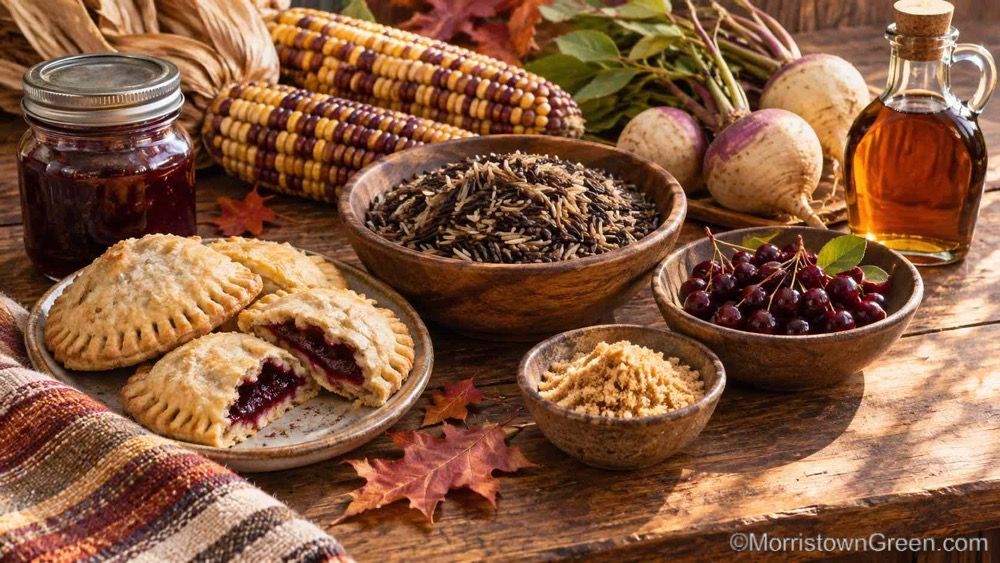
Wild plum jam, made by my maternal grandmother, Grandma Hoblit, became the filling for one of my favorite childhood treats. She taught me how to make her plum tarts. The pie dough was rolled out and cut into circles using a drinking glass. A spoonful of jam went in the middle, a little water around the edges to seal the top, and finally a prick with a fork. She would let me have one as soon as it had cooled enough to eat. It was a simple lesson in baking, but one that has stayed with me.
Dried corn was another staple that my grandmother prepared herself. She used it to make a soup with a few timpsila (prairie turnips) taken from a braid hanging in her kitchen. She simmered the soup with meat for a long time. But the timpsila had their own special place in the experience. We ate them by holding the stem in our hands and chewing the turnip. It was part of the ritual of eating that dried corn soup.
Another favorite ingredient is molasses. My paternal grandmother, Grandma Lekberg, would make me warm milk with a spoonful of molasses stirred into it. The flavor was strong and sweet, with a little bitterness, softened by the creaminess of the milk. I still crave that warm milk. It seems to be just what I need when I’m looking for comfort.
These memories have shaped the way I think about food. Ingredients are not simply things we purchase and combine. They connect us to family, to traditions, and to the people who taught us how to prepare and appreciate them.
More recently, I’ve had opportunities to explore those connections in new ways. I had the opportunity to cook in the kitchen at the James Beard House in New York City with Chef Sean Sherman, a fellow citizen of the Oglala Lakota Oyate. Later, during a trip out west, I traveled to Minneapolis, where I staged and shared a meal at Indígena by Owamni, Sean’s restaurant.
While in Minneapolis, I also had the opportunity to talk with Andrea Weber, the Institutional Executive Chef at NATIFS (North American Traditional Indigenous Food Systems). Andrea was working on a project to provide traditional buffalo stew to students and elders. It was one of many meaningful projects she has worked on, using food to bring people together and provide nourishment in a purposeful way.
I’ve always valued the thought and care that go into providing a meaningful meal. It isn’t just about what is served. It is about who is being fed, the ingredients being used, and the connections that food can create.
Now back in Morristown, with Thanksgiving approaching, I’m thinking about the ingredients I want to bring into this year’s meal. I ordered wild rice, wild rice flour, chokecherry jelly, maple sugar, chile honey, and dried and roasted corn from NATIFS.
Wild rice is the seed of an aquatic grass native to North America. It has a long history of being harvested, shared, and sustaining Indigenous communities across generations.
This year, I’m responsible for the gravy, bread, a side dish, and dessert for Thanksgiving, followed by a meal made from leftovers on Sunday. I’m also drawing inspiration from a culinary experience that has stayed with me: Mitsitam Native Foods Cafe at the Smithsonian’s National Museum of the American Indian in Washington, D.C.
The menu was organized by the regions of the Americas, and as you walked through the cafe, you could smell the aromas of the different regional foods. I had never been so aware of the diversity of Indigenous food traditions and the ways food reflects the land. The range of ingredients and flavors, along with the immersive experience, left a lasting impression on me. The menu made the connection between the land and the foods it could sustain especially clear.
For this year’s meal, here’s what I’m planning:
Thanksgiving Menu
- Warm wild rice, roasted turnip, and dried blueberry salad with apple cider dressing
- Chokecherry and cranberry gelée
- Parker House rolls with sage and honey butter
- Pumpkin pie with a wild rice flour crust, or pumpkin cake made with wild rice flour and maple sugar, served with vanilla ice cream and molasses caramel
The dried and roasted corn will find its way into a soup made with leftovers for Sunday’s meal.
I’m looking forward to experimenting with wild rice flour in my Thanksgiving baking. The chokecherry and cranberry gelée will also bring a familiar flavor into something new, much like the wild plum jam my grandmother used to make.
What interests me most is the opportunity to learn from these ingredients, make something delicious, and understand their place in the meal and in a larger food system. Bringing these foods into my kitchen is meaningful because of the people who have cared for them, shared them, and kept their traditions alive.
Food has always been one of the ways we establish a sense of belonging. It connects us to family, to place, to memories, and to one another. The things we grow, gather, prepare, and share tell stories about who we are and where we come from. They also remind us that food traditions are not static. They evolve as we learn, as cultures meet, and as we make room for new understanding.
This is also part of what Thanksgiving can mean. It is one of the most widely shared holidays in the United States, bringing people together around tables in homes across the country. Acknowledging the Indigenous people who were here long before the arrival of European settlers, their histories, knowledge, and relationships with the land are an essential part of this country’s story.
And Indigenous people are still here creating, teaching, farming, harvesting, cooking, building businesses, and carrying their cultures forward. The work of organizations like NATIFS, along with the chefs and food producers who share and sustain Indigenous food traditions, is part of that continuing story.
This Thanksgiving, I’m thankful for kinship, for the family stories and traditions that have shaped me, and for the people who continue to share their knowledge and keep food traditions alive.
I’m thankful for the ingredients that connect us to the land and to one another, and for the opportunity to learn more about where our food comes from, whose hands and knowledge have made it possible, and how we can carry that understanding forward.
I’m also grateful for the local food community here in Morristown, from our farmers markets to organizations like the Foodshed Alliance and Grow It Green Morristown, which help keep us connected to local farms, food, and the people who make it possible.
I’m equally grateful for the organizations working to protect the farmland, open spaces, and waterways that sustain our communities, including The Land Conservancy of New Jersey, Harding Land Trust, Schiff Natural Lands Trust, the Great Swamp Watershed Association, and the many other local conservation groups caring for the land around us.
Andrea Lekberg is an artist, chef, and former owner of The Artist Baker, the Morristown bakery she operated for nearly 18 years. She is a graduate of the School of the Art Institute of Chicago, and her work is included in In and Out of Place, an exhibition organized by the Center for American Indian Research and Native Studies (CAIRNS), which explores the return of fossils to Native lands. Most recently, her artwork was featured at Merzatta in Morristown, where a textile mask and star-shaped quilt incorporating beaver fur responded to the exhibition’s themes of place, belonging, and return.
Opinions expressed in commentaries are the authors’, and do not necessarily reflect those of this publication.
Giving Tuesday · Dec. 1
You just read local news. Double it.
No paywall, no billionaire. Just neighbors who chip in. Through Dec. 1, a Morristown neighbor will match every gift dollar for dollar, up to $10,000.
Double your impact
A Morristown neighbor matches every gift, dollar for dollar, up to $10,000.
Secure checkout by PayPal. Pay with PayPal, Venmo or a debit or credit card. Monthly gifts can be cancelled anytime. Gifts through PayPal aren’t tax-deductible.