From Apple’s greatest hits to the secret lives of chickens, from the art of writing obituaries to the perils of giving fantasy characters flaming wings, Saturday’s Morristown Festival of Books offered something for just about everyone.
Bestselling authors shared laughs, writing secrets and unexpected insights with audiences at venues across downtown Morristown. Some offered practical advice. Others revealed the frustrations behind their successes. And a few reminded us that truth can be stranger — and funnier — than fiction.
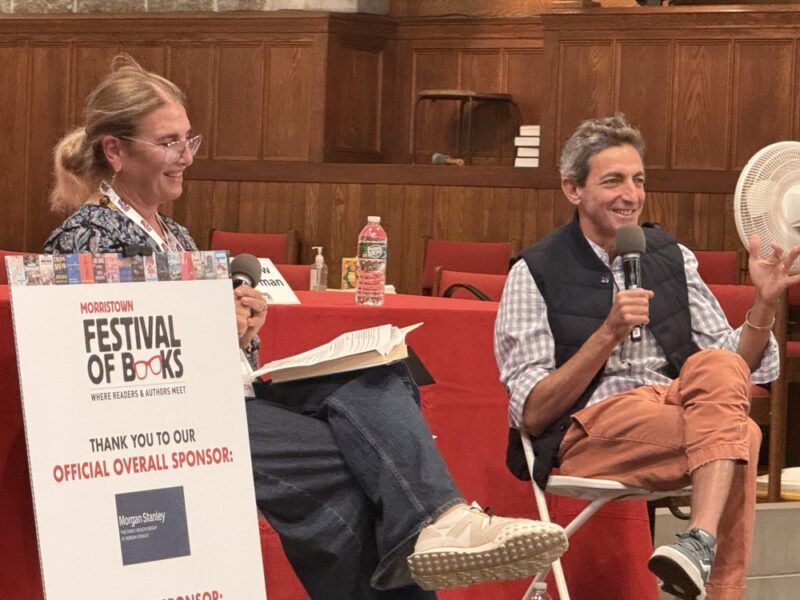
Here are some highlights from the festival’s 13th edition, as captured by Morristown Green editor Kevin Coughlin and correspondents Kristen Neymarc and Marion Filler.
POGUE ON APPLE
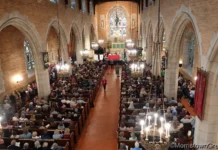
Many of the fans who crammed St. Peter’s Episcopal Church to hear David Pogue discuss his latest best-seller, Apple: The First 50 Years, were familiar with key elements of this garage-to-riches saga: From late co-founder Steve Jobs’ obsessions with rounded corners and impossible deadlines through early flops (the Lisa) and spectacular successes (iMac, iPod, iPhone).
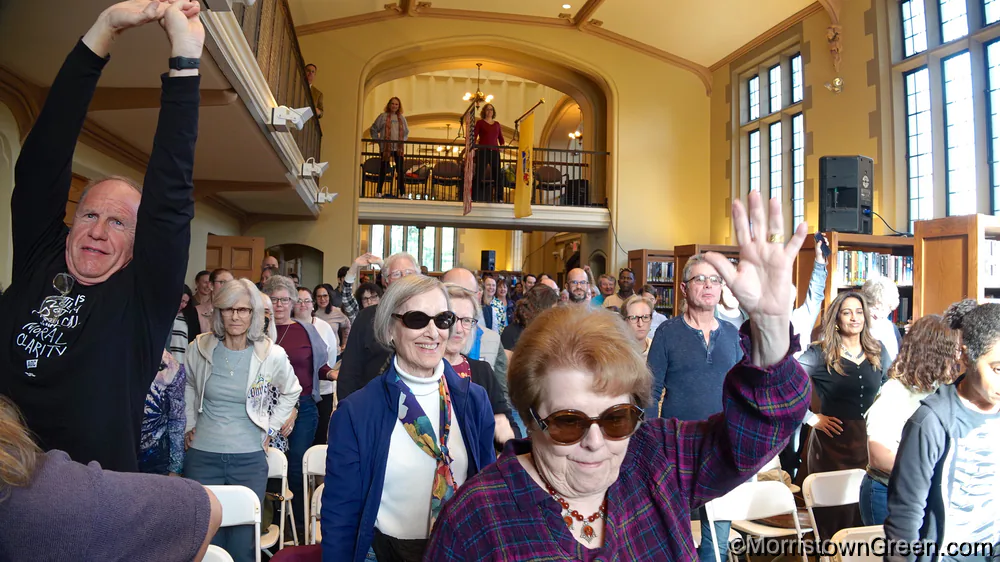
They probably knew about the company’s legal battles with the Beatles’ Apple Records.(What’s in a name? Mega-millions, it turns out.) Maybe, some had heard about Apple’s $10 billion missfire with the self-driving Apple Car. At least 10 audience members were well aware of how Tim Cook steered Apple towards the medical industry — they raised their hands when asked if the Apple Watch had alerted them to serious health conditions.
What may have come as a surprise was the author’s musical prowess.
Before Pogue, 63, racked up his seven Emmys on CBS Sunday Morning and hosted 20 PBS Nova specials, before his countless tech columns for MacWorld and the New York Times, before he sold all those manuals For Dummies… he conducted and arranged Broadway musicals.
He showed off his Yale music degree Saturday at an electric piano, pounding out some hilarious parodies: Don’t Cry for Me Argentina became Don’t Cry for Me Cupertino; I Did It My Way transformed into I Need an iPhone. Pogue had the faithful dutifully clapping along to his version of Pharrell Williams’ Happy:
Clap along if you’ve never thrown away the box
Got a special closet just for dongles or for docks
Clap along if you bought that stand for a thousand bucks
Clap along if you feel that Siri still kinda sucks!
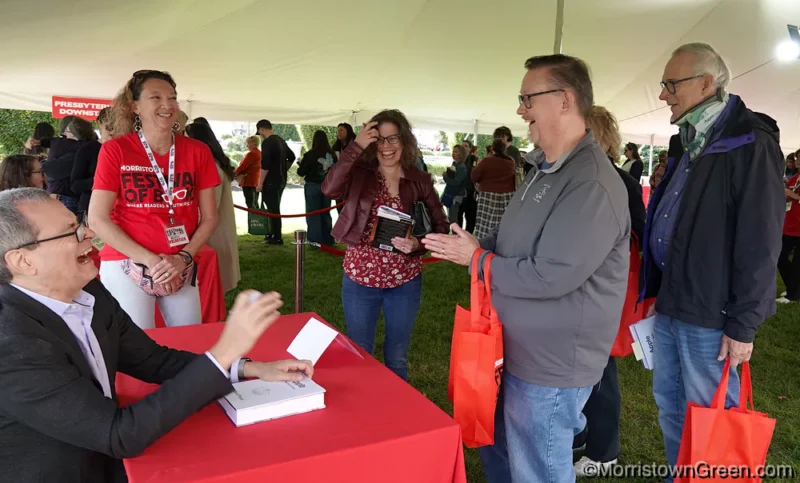
That alone was worth the price of admission. Wait…it was free! But afterwards, Pogue’s line at the book sale tent looked like an Apple Store on the eve of a new iPhone release. Music to his ears. —Kevin Coughlin
ANNA QUINDLEN: WRITING ‘IS SO HARD’
After a Pulitzer Prize for her New York Times columns and more than 20 fiction and nonfiction titles, one would think Anna Quindlen has her art down to a science. But she said John Steinbeck nailed it: I am so lazy, and the thing is so hard.
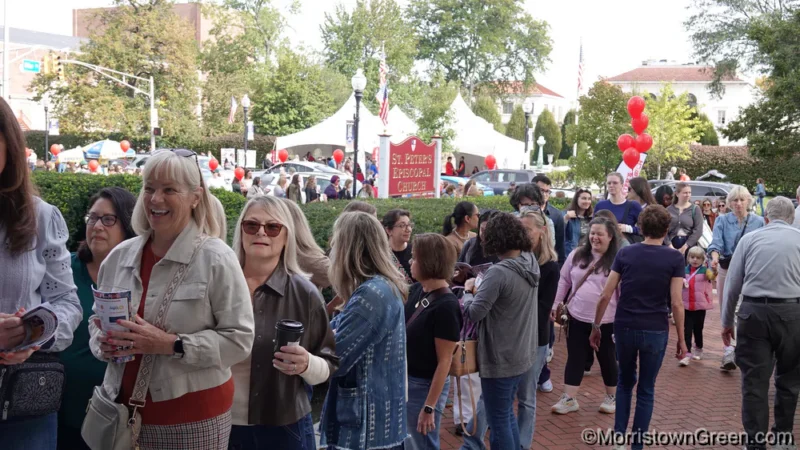
“I say that every morning,” she said Saturday inside St. Peter’s Episcopal Church, before arguably the largest crowd in the 13 years of the Morristown Festival of Books.
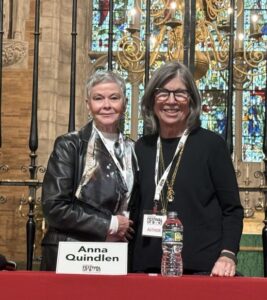
Quindlen, 74, was there to talk about More Than Enough, her new novel about friendship, aging and family relationships. Julie Maloney was moderator.
A women’s book club is at the heart of the story. Its members choose a book every month, buy it and leave it on their coffee tables. Reading it? That’s practically against the rules. One character even accuses another: “You read the book.” The audience roared knowingly.
(Wendy Supron, chair of the Festival, insists her selection committee reads everything on the roster.)
For Quindlen, writing as “an exercise in confidence” — daunting in a world with such masterworks as Steinbeck’s East of Eden and Tolstoy’s Anna Karenina. She counsels young writers that the one thing they can offer is personality.
“My God, to get them to honor their own voice is so hard— it requires them to get up and say, ‘I have a voice, and I have something to say,” she said. Fresh viewpoints are imperative, she believes, for the future of literature — and for a healthy society. “The greatest problem today is people aren’t walking in someone else’s shoes.”
To encourage aspiring writers, Quindlen shows them her heavily marked-up manuscripts. Revision is not failure! Responding to an audience question, she said endings to her novels take her by surprise. “I type…and think, ‘That’s the last sentence.'”
She longs for a day “when some lovely editor says, ‘Anna, it’s perfect as it is.'”
With a laugh, she hastened to add: “So far, that has never happened.” — Kevin Coughlin and Kristen Neymarc
WHO ARE YOU CALLING CHICKEN?
Ninja chickens. Neurologically impaired squirrels. Throw in dogs, whales, bunnies and octopods, and you may come away with a new way of looking at the animal kingdom.
That’s what happened Saturday at the Morristown & Township Library, courtesy of authors Michelle Lerner and Jeff Campbell.
“I’ve lived with a lot of animals,” said Lerner, who has recounted her adventures in A Series of Opinionated Animals, a memoir. Each of her subjects are animals she either knew or cared for. They include Stephanie, an unforgettable ninja chicken who attacked her on her first day of work after graduation.
Campbell chimed in about a very different chicken he knew — the peacemaker of the hen house, intervening between warring parties when there was a fight.
“Chickens are ridiculously smart,” said Campbell, co-author of Love in their Hearts with Marc Bekoff, an expert in cognitive ethology, the science of understanding conscious awareness and intention in animal behavior.
“It isn’t just species, added Campbell, a Morristown resident and author of several children’s books. “You can’t generalize.” He compared the range of personality in animals to the immense range within humans, and gave examples of similarities.
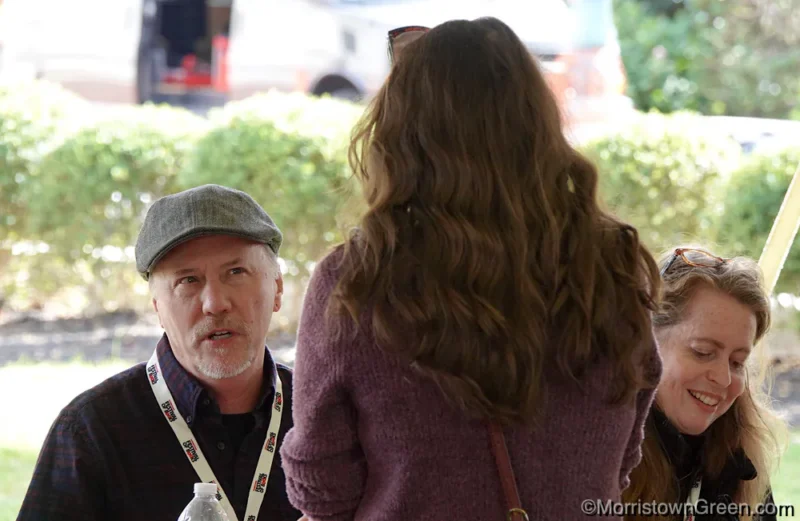
Close observation is the key to discovery, he emphasized. “Once we start paying attention, we start learning things.” For example, a recent study demonstrated that moral responsibility is a behavior commonly shared by species.
“If animals don’t play fair, then they can’t play, and if they don’t agree to play fair, they can’t play. What looks like dogs fighting can be play so long as both want to get along. But as soon as one doesn’t want to, then it becomes an attack.”
Dogs also can negotiate, as witnessed by Lerner in her own home. One of her pets relentlessly nudged another to play with her, but he refused to budge. She didn’t give up, taunting him with his favorite stuffed toy until he relented.
“These are minds at work,” quipped Campbell.
“We make a lot of assumptions and have expectations about certain species,” added Lerner. There’s a whole culture about how to make animals fit into your life and fit them into boxes. She believes it is better to establish boundaries and let them communicate how they see the world instead.
The concept of Citizen Scientists, ordinary people of all ages who observe animal behavior and ask questions, are a vital part of new discoveries across all species, Campbell said. He described how a fisherman saw humpback whales saving baby seals from sharks and wondered what it could mean.
Was it an isolated incident or a meaningful act, the fisherman asked? Are animals altruistic?
“We never thought to look for a connection so we never found it,” observed Campbell. But this time was different, someone saw it, and asked a question that inspired a widespread response. And a whole new field of study was born. — Marion Filler
SAM ROBERTS: ANGEL OF DEATH?
Think hard before accepting a call from Sam Roberts.
He’ll tell you he’s “updating your biography.” He’s writing your obituary.
Roberts has spent the last decade of his half-century in New York journalism authoring some 1,500 obits for the New York Times. Another 2,000 are works-in-progress, constantly being updated until an R.I.P. finally is added to a celebrity’s resume.
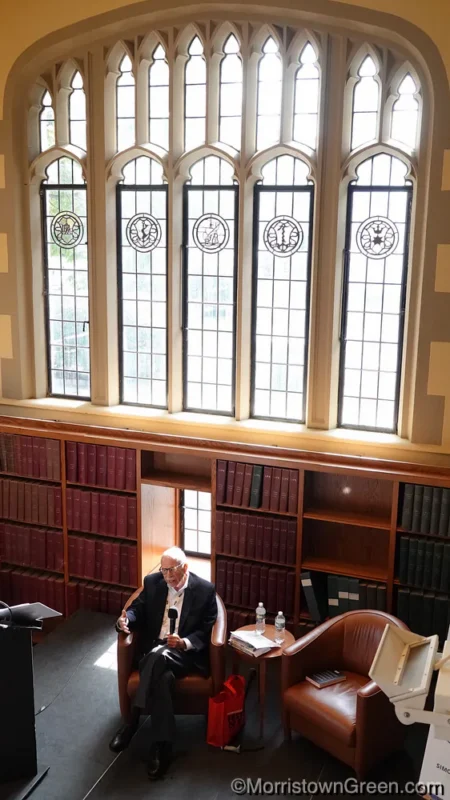
It’s a tough job. Every day, about 150,000 people die worldwide. Only three or four make the Paper of Record, said Roberts, interviewed Saturday about his new book, Are They Dead Yet? The Art of the Obit by Morristown & Township Library Director Chad Leinaweaver.
Your chances of making the obit page used to be pretty good if you were a white banker or financier. Novelty always helps: The woman who posed as Rosie the Riveter for those World War II recruitment posters, say, or the inventor or the TV remote control (father of generations of Couch Potatoes).
Roberts said things became a little more egalitarian after The Times’ Portraits in Grief series memorialized every 9/11 victim. But it’s still a subjective process he can’t fully explain.
Somber stuff — yet the library session was mercifully humorous. Roberts, 79, confided he’s reluctant to share his occupation with people. “It’s kind of a conversation-stopper,” he deadpanned.
He grew up in a Brooklyn family that didn’t like talking about death. His aunt covered up a relative’s expiration by saying he simply “was away.” Young Sam: “Oh, how’s he doing?” Aunt: “So-so.”
Times obit writers have two rules: Never show a subject his or her advanced obituary, and never publish their quotes until they’re dead. When an editor pushed for a sneak peek at his own obit, the writer held firm. “I won’t show it to you,” Roberts quoted the writer as saying. “But when you see it, you’re gonna love it.”
When Roberts was updating an obit on David Rockefeller, then still living, someone called to remind him that Rockefeller had outlived his last three obituarists.
Obviously, writing the last word about anyone is serious business. Every human being is important, Roberts said, and he strives to learn — often on deadline — what motivated the deceased in life, and to portray the person accurately while staying mindful of survivors’ grief.
That’s not always easy. The Times got heavy blowback for including controversial statements by Charlie Kirk in its obituary of the assassinated right-wing activist. Former New York Mayor Rudy Giuliani, a hero of 9/11 whose fortunes have taken a dramatic turn, has required extensive updates.
“An obit is not a eulogy, not an encomium,” Roberts said. Never satisfied with the finished product, he said he has yet to find a detail like the “Rosebud” sled that defined the dead subject in Citizen Kane.
Roberts has drawn inspiration from two obits. The sister of late New York Mayor Ed Koch called him to say she had terminal cancer and wanted to explain her decision to commit legally assisted suicide. Another, still in progress, portrays a former college president’s upbeat demeanor despite a grim diagnosis.
And then there is the one that the Times wouldn’t touch. The paper launched a project to post obits for important people it’s missed over the years. So Roberts tried to imagine how the Times would have reported the death of Jesus Christ two millennia ago.
For that, you’ll have to buy the book. — Kevin Coughlin
MANOUSH ZOMORODI: GET MOVING!
Before you read this, stand up and do the Zoom Shuffle.
You know, the little dance you (should) do when you switch off your video during webinars. Shift gently back and forth for a few minutes.
There! Doesn’t that feel better?
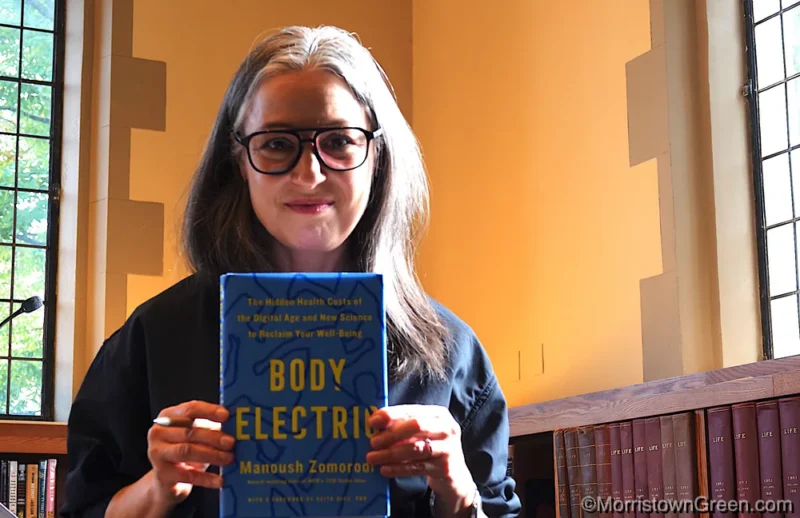
That, in a nutshell, is what NPR’s Manoush Zomorodi is prescribing in her new book, Body Electric. In conversation Saturday at the Morristown & Township Library with moderator Tara Bernie of TB Yoga House, Zomorodi discussed findings from a public health study she participated in at Columbia University Medical Center along with 23,000 public radio listeners she solicited.
An award-winning journalist and host of NPR’s The Ted Radio Hour, Zomorodi, 52, had wondered why she felt so listless after workdays spent at her computer. Then she heard about the study led by Keith Diaz, a physiologist at Columbia.
The study, Zomorodi said, suggests that fatigue, joint pain, brain fog and myopia (shortsightedness) may be alleviated by short, regular movement breaks from computer- and mobile screens — without hurting productivity.
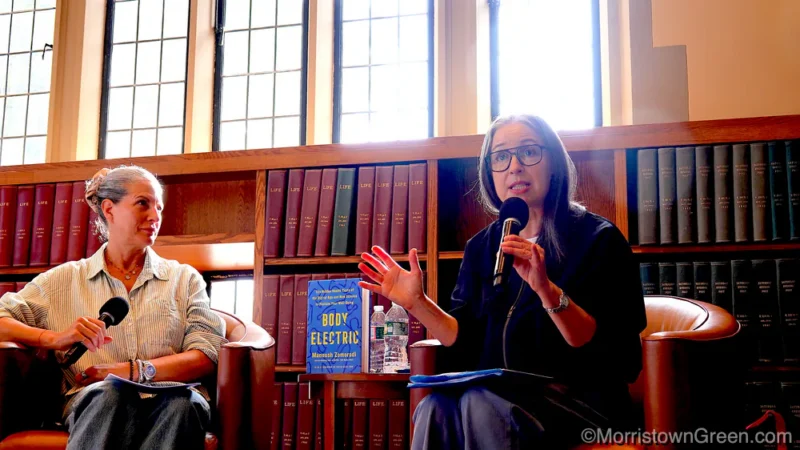
“Don’t think of this as exercise. It’s what your body needs,” Zomorodi told a big crowd.
She compared prolonged sitting to kinking your circulation like a garden hose. (Curiously, working at a standing desk for extending periods poses its own risks, namely blood clots, she claimed.) Morning workouts, though beneficial, won’t compensate for afternoons parked at the computer, she asserted.
In other words, fidgety little kids know what they’re doing.
Sleep is really important, of course. Good sleep habits count — go offline hours before bedtime! — although blue light from screens may not be as disruptive as previously thought, she said.
Habitually focusing on screens can alter eyeball shape, causing myopia, Zomorodi said. If you’re under 30, she said, this may be mitigated with outdoor breaks and doing what nature designed our eyes to do — looking all around. She touted birdwatching with your kids.
Zomorodi said just one day of movement for a few minutes each hour in a Columbia lab improved her energy and resulted in measurable physiological changes. The study was published in the peer-reviewed British Journal of Sports Medicine in June.
Disclaimer: None of this is intended as medical advice. See a medical professional (not a chatbot) for persistent concerns. That being said, Zomorodi suggested it’s never a bad idea to follow the basics: Movement, real-world friendships, a diet rich in colors and fiber, and activities that gives you purpose and joy.
“Faster, faster, faster isn’t better,” she said. —Kevin Coughlin
CONFESSIONS OF TWO ROMANCE NOVELISTS
Romance novelists Annabel Monaghan, author of Dolly All the Time, and Tessa Bailey, author of Broken Rival, entertained their audience at St. Peter’s Episcopal Church with an irreverent discussion of writing, inspiration and the peculiar difficulties of making a living inventing love stories.
Monaghan said she had taught novel writing in Sarah Lawrence College’s adult education program for three years.
“No one learned anything,” she confessed.
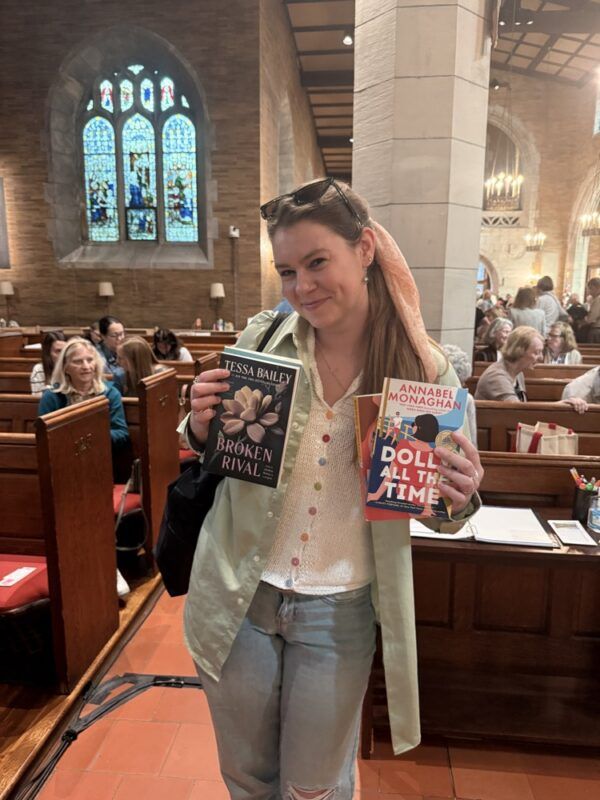
She was particularly unsparing about her own teaching abilities. “When I was teaching, it was basically like therapy for writers.”
Students brought their stories, she offered encouragement, and nobody finished a book.
Monaghan said she has to teach herself how to write a novel every time she starts one. Bailey agreed there is no universal formula: Every writer brings different experiences and insecurities to the process.
Their humor, self-deprecation and willingness to bare their souls were striking. Rather than presenting themselves as experts who had mastered their craft, the two bestselling authors spoke with remarkable candor about how much they still have to learn. Maryann McFadden moderated the discussion. – Kristen Neymarc
A MICROPHONE MYSTERY
A discussion of true crime developed an unexpected mystery: Would anyone get the microphones to work?
Audience members in the Presbyterian Church Parish House repeatedly called out that they couldn’t hear the introductions. Retired FBI official Frank Storey, discussing The FBI’s War Against the Mafia, was interrupted when his mic cut out.
Benjamin Hale, author of Cave Mountain, approached the sound system with understandable caution.
“I feel like this mic and sound system is extremely volatile. I’m a little afraid.”
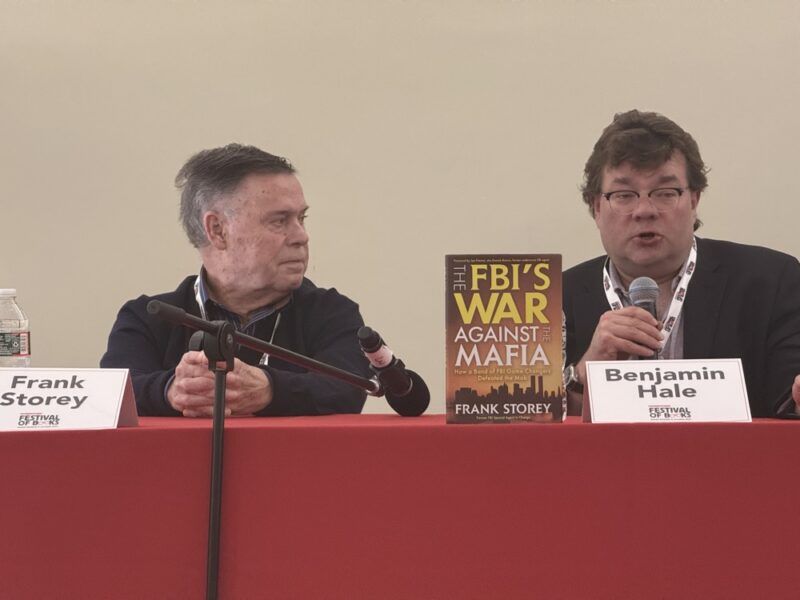
The technical difficulties eventually gave way to two very different criminal investigations: Storey’s account of the FBI’s campaign against organized crime, and Hale’s extraordinary story involving a missing child, an imaginary friend and a long-buried murder.
Hale, in a conversation moderated by Jacob Soule, reflected on the improbable coincidences that helped bring the truth to light.
“The thing about fiction is that it has to make sense, whereas nonfiction is about reality, which has no obligation to make sense.” — Kristen Neymarc.
THE PROBLEM WITH WINGS OF FIRE
Fantasy writers can invent entire worlds. But then they’re stuck playing by the rules they’ve created.
Jean Kwok, author of Dominion, explained to listeners in the Presbyterian Church Parish House that in her fantasy series, she decided that royalty in one kingdom could fly on enormous wings of fire.
“Wings of fire! Like, how cool would that be,” she recalled thinking. Then came an inconvenient detail. “Oh, clothing, like flammability, oh.”
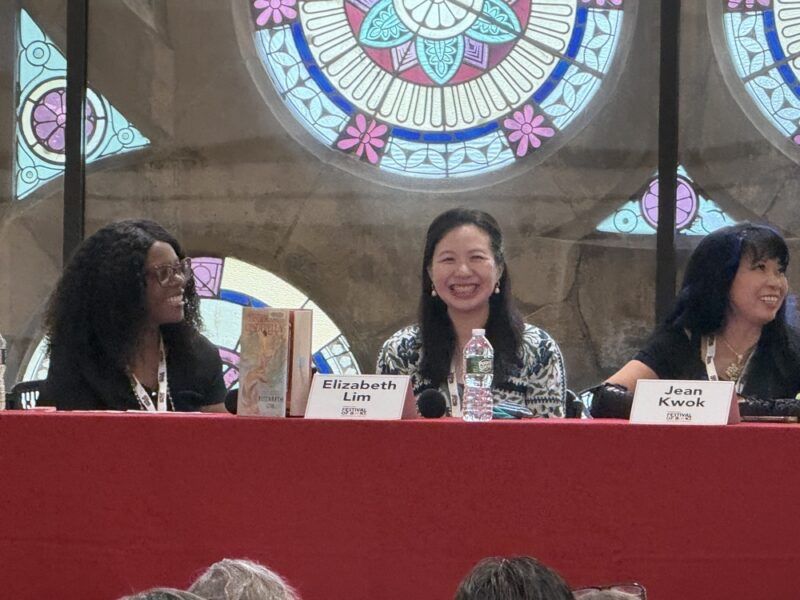
Worse, she already had mentioned the wings in an earlier book, so there was no going back. Fortunately, she told moderator Tynisha Coleman, she remembered that she also had invented fireproof fabric, allowing her characters to keep their wings without setting their clothes ablaze.
Fans ate it up, practically falling off their seats with laughter as Kwok shared the hilarious behind-the-scenes details of building her imaginary world.
Elizabeth Lim, author of Fishbone Cinderella, took a different approach to magic, drawing on her grandmother’s memories and Cantonese heritage. In her novel, three generations of women possess different powers: One can become invisible, another can see the future, and the third can see the past. Their abilities reflect the tensions and connections between generations. —Kristen Neymarc
COCO GAUFF IS SERVED A SURPRISE PROTEST
Tennis journalist Matthew Futterman, author of The Cruelest Game, had the easygoing confidence of a veteran reporter who clearly loves telling stories.
Comfortable in the spotlight, he offered long, entertaining answers, peppered with anecdotes and the occasional digression at the Episcopal Church of the Redeemer, in conversation with moderator Karen Gruenberg.
When asked to recount a highlight from his years covering tennis, he chose his encounter with Coco Gauff at the 2023 U.S. Open. He described it as “one of the moments that I’m sure will never repeat itself.”
Climate protesters had interrupted her semifinal, throwing the stadium into confusion. Futterman headed downstairs to find tournament officials, expecting Gauff to be furious about the disruption.
Instead, he found the star smiling, almost delighted. She was pleased, Futterman explained, because protesters had selected her match rather than those of her fellow American players. She would now have bragging rights over her friends.
For Futterman, a staff writer for The Athletic who previously wrote for for The New York Times, The Star-Ledger and The Philadelphia Inquirer, the incident illustrated something essential about elite athletes: Their ability to control their reactions when circumstances threaten to derail them.
But becoming a professional tennis player, and making a living at it, is another challenge altogether. Futterman estimated there are only about 80 good jobs in men’s tennis and 80 in women’s tennis. Unlike NBA players, tennis professionals are independent contractors who pay their own expenses.
“You eat what you kill,” he said.
Outside the top 20, earnings fall sharply, and by around No. 80, a player may barely break even. By contrast, Futterman noted, the 50th-best basketball player in America could be earning $20 million annually in the NBA, with a salary that continues even if he gets injured.
And tennis demands extraordinary adaptability.
Noting the sport’s many playing surfaces, he invited the audience to imagine a basketball season played on hardwood, then ice, then mud. -Kristen Neymarc
THE MUSEUM OF LOST THINGS
Sam Kean is a man of boundless curiosity and a prolific writer with a penchant for museums — not necessarily for what is in them, but for what is not.
“I love going to museums, I could spend hours wandering around them but I think about history too, and am often struck by all the destruction and things that have been lost in the past.”
At the Morristown & Township Library, Kean discussed his book, The Museum of Lost Things, in a conversation moderated by archaeologist and historian Judith Lindbergh.
No one could be absolutely sure that Troy was real and not a myth, Kean said. But Heinrich Schliemann, a German businessman and amateur archaeologist, was determined to find it. Against all odds, he succeeded.
There was a downside. Schliemann found numerous gold artifacts but, ignoring scientific protocol, removed them from their original locations and put everything in another spot.
“He wanted to claim he found a great treasure. But he ruined it for other archaeologists, who since then are trying to undo what he did and trying to figure out what really happened in Troy.”
Was the supposed rivalry between Leonardo da Vinci and Michelangelo fact or fiction?
“They were certainly opposites,” Kean said. Leonardo didn’t finish much. “In fact, he only produced 15 works in his lifetime over the 40 or 50 years he was doing art. He abandoned a lot of projects and was easily distracted.”
Michelangelo, on the other hand, was hyper-focused. He would stop bathing, eat stale bread crusts and just keep working, Kean said.
The Mona Lisa was not widely known until a Louvre employee stole it, Kean said. Suddenly everyone was talking about the painting. It nearly was destroyed, but its theft and return made headlines worldwide.
“It makes you appreciative and thankful for how much we’ve been able to hold on to.”
Kean said a good science story requires characterization, suspense, a hero, a villain and a satisfying resolution. Among his favorites is the wild legend of Genghis Khan’s hidden grave.
“A thousand soldiers took his body to the mountaintop, but in order to keep the location secret, slaughtered everyone they saw along the way. Coming back down, they killed any survivors, and when the soldiers reached camp, they too were killed to keep the secret safe.”
The lost Library of Alexandria prompted a discussion of how to preserve our own civilization’s knowledge when so much has been destroyed by conquest or neglect.
“The best way to preserve information is in physical form,” said Kean, who prefers books to digital records. “In a million years, they will not be able to access cell phones and computers because they won’t have the software.”
His other advice: Scatter material far and wide.
“Don’t put all your eggs in one basket (or one library for that matter). We’re always finding things in people’s attics.” — Marion Filler
MORE FROM THE 2026 MORRISTOWN FESTIVAL OF BOOKS
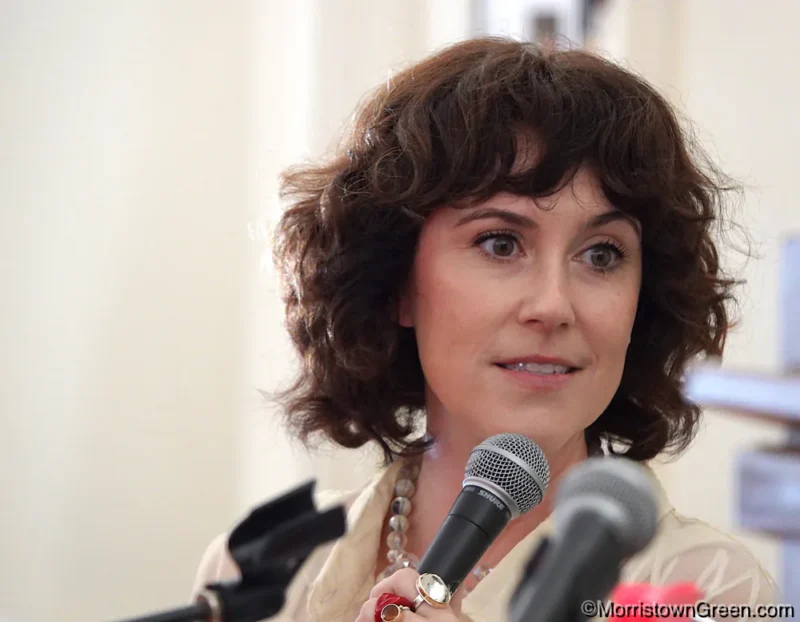
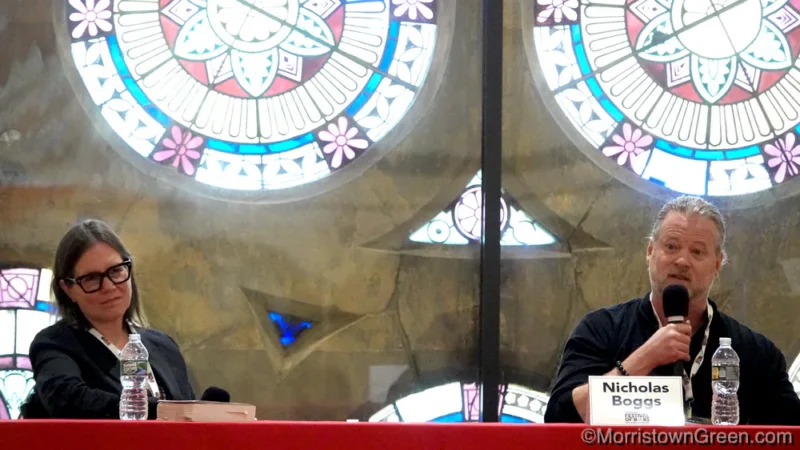
Morristown has a long history of people stepping forward in pivotal moments.
When you chip in to Morristown Green, you’re helping your neighbors stay informed, strengthening our civic backbone, and carrying on the spirit that’s defined this town since its earliest days.
Rally for local news.