By Kristen Neymarc
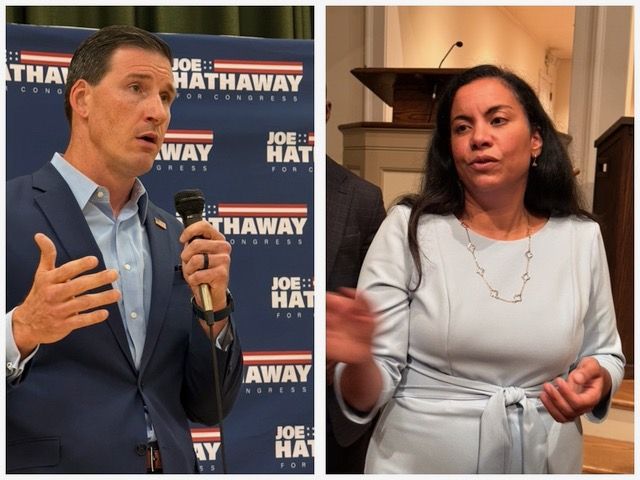
The NJ-11 rematch is heating up fast, with Democratic Rep. Analilia Mejia and Republican Joe Hathaway increasingly defining the race by what they say is wrong with the other.
Just six months ago, Mejia defeated Hathaway in an April special election for New Jersey’s 11th Congressional District — which includes parts of Essex, Morris and Passaic counties — 81,825 votes to 53,520 districtwide. Now, Mejia is the incumbent and Hathaway is seeking to unseat her in the Nov. 3, 2026, election.
The language has become increasingly sharp.
Hathaway said the election was an opportunity to “return to sanity.” He accused Mejia of pursuing a “radical agenda,” said she “wants to shape narratives and create villains,” and charged that she “won’t even agree to deporting hardened criminals in this country illegally.”
Mejia hit back. She called Hathaway’s continued alignment with Trump “ridiculous” and “out of step with New Jersey voters,” tying him to a president she said was “willing to threaten the Constitution” and to policies “making us less safe.”

On immigration, she said “Donald Trump and Republicans like my opponent” were producing chaos rather than security — arresting “grandmas and gardeners” instead of the “worst of the worst.”
The back-and-forth may make for lively campaign coverage, but voters need more than what the candidates say about each other. Where do they stand on taxes and health care, immigration and ICE, presidential power and war? What would they do about artificial intelligence? And where, if anywhere, would they break with their own political camp?
In other words, how they would govern?
To make those positions directly comparable, Morristown Green gave Mejia and Hathaway he same eight policy questions, the same 200-word limit and the same deadline. Each also received one tailored question about political independence.
Mejia answered eight of the nine questions. She left the political-independence question unanswered. Hathaway answered all nine.
AFFORDABILITY: STARTING FROM DIFFERENT PLACES
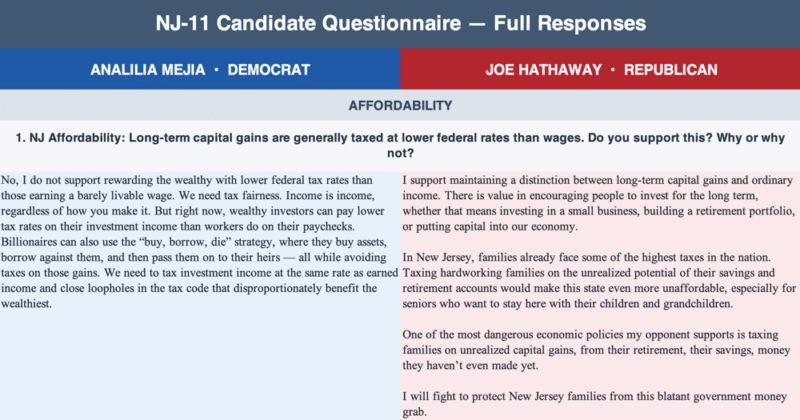
The first question went straight at an issue both campaigns emphasize: Affordability.
Asked whether long-term capital gains should continue to receive lower federal tax rates than wages, Mejia answered no. “Income is income, regardless of how you make it,” she wrote, arguing that investment income should be taxed at the same rates as earned income and that tax provisions benefiting wealthy investors should be closed.
Hathaway took the opposite view. “There is value in encouraging people to invest for the long term,” he wrote, whether in a small business, a retirement portfolio or the broader economy. He also attacked proposals to tax unrealized gains, money he described as gains families “haven’t even made yet,” calling that a “blatant government money grab.”
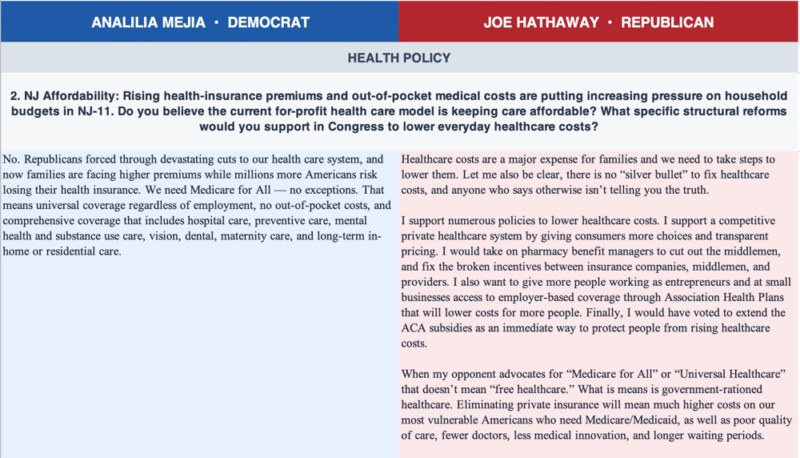
Their health-care answers exposed an equally clear divide.
“We need Medicare for All — no exceptions,” Mejia wrote, calling for universal coverage regardless of employment, no out-of-pocket costs and coverage encompassing hospital, preventive, mental-health, substance-use, vision, dental, maternity and long-term care.
Hathaway rejected a government-run system. “There is no ‘silver bullet’ to fix healthcare costs,” he wrote. He advocated retaining competitive private insurance while increasing price transparency, changing incentives involving pharmacy benefit managers and expanding Association Health Plans for entrepreneurs and small businesses. He also said he would have voted to extend Affordable Care Act (Obamacare) subsidies.
And he again took direct aim at Mejia, arguing that Medicare for All would mean “government-rationed healthcare,” with higher costs, fewer doctors and longer waits.
DIFFERENT ROUTES, SAME ANSWER ON ROXBURY DETENTION CENTER
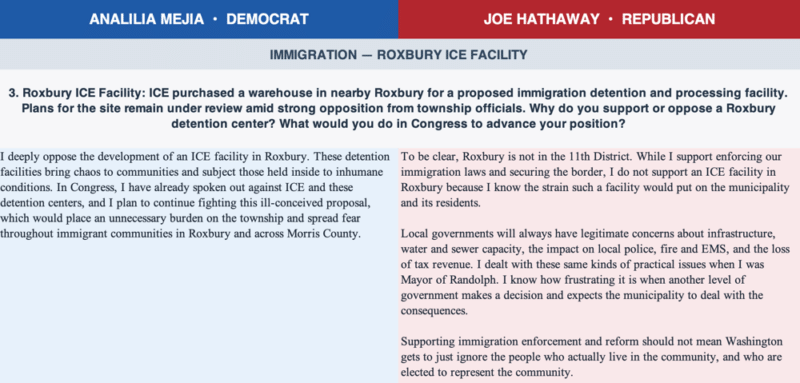
The proposed ICE detention and processing facility in Roxbury produced one of the questionnaire’s clearest points of agreement: Both candidates oppose it.
But their reasons sound very different.
“I deeply oppose the development of an ICE facility in nearby Roxbury,” Mejia wrote, saying detention centers “bring chaos to communities” and subject people inside to “inhumane conditions.” She said the proposal would burden the township and “spread fear throughout immigrant communities in Roxbury and across Morris County.”
Hathaway began by emphasizing that “Roxbury is not in the 11th District” and that he supports enforcing immigration laws and securing the border. But he also opposes the facility, citing the potential strain on local infrastructure, police, fire and EMS services and the loss of tax revenue.
“Supporting immigration enforcement and reform should not mean Washington gets to just ignore the people who actually live in the community,” he wrote.
SOME OVERLAP ON IMMIGRATION — AND A SHARP DIVIDE OVER ICE
Their answers on broader immigration policy revealed an area of partial agreement.
Mejia called for a “fair and just immigration system,” due process and equal protection under the law, along with “a pathway to citizenship.”
Hathaway said people who have been in the country for years, are “working hard, paying taxes, contributing to their community and staying out of trouble” should have “a pathway for them to earn legal recognition.”
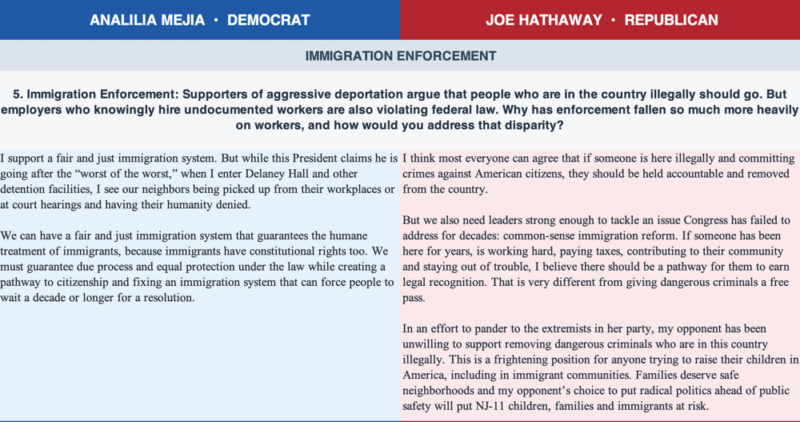
But the overlap largely ends there.
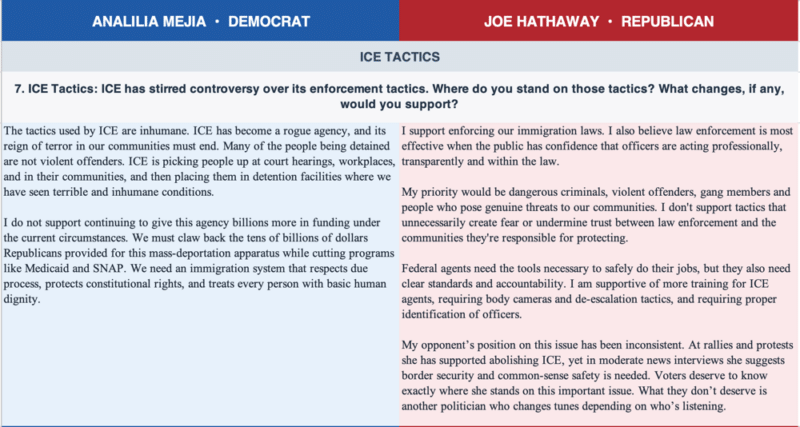
Mejia described ICE as “a rogue agency” whose “reign of terror in our communities must end.” She said Congress should claw back billions in additional ICE funding and argued that many people being detained are not violent offenders but are instead being picked up at workplaces, court hearings and in their communities.
Hathaway said his enforcement priority would be “dangerous criminals, violent offenders, gang members and people who pose genuine threats to our communities.” He said ICE agents should face “clear standards and accountability,” and endorsed body cameras, proper identification, de-escalation tactics and additional training.
He also directly challenged Mejia’s position, accusing her of changing “tunes depending on who’s listening” and saying voters deserve to know exactly where she stands on ICE.
WAR AND PRESIDENTIAL POWER
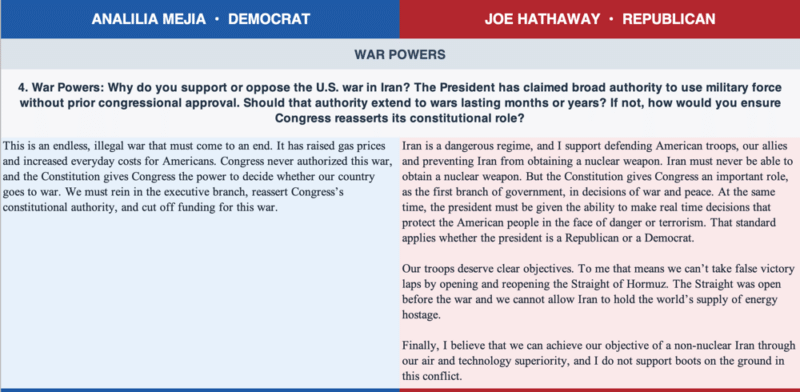
On the war in Iran, Mejia was unequivocal.
“This is an endless, illegal war that must come to an end,” she wrote. She said Congress never authorized the conflict, should reassert its constitutional authority over war and “cut off funding for this war.”
Hathaway took a different approach. “Iran must never be able to obtain a nuclear weapon,” he wrote, while also acknowledging that Congress has an important constitutional role in decisions of war and peace. He said presidents need the ability to respond to immediate threats and opposed putting U.S. troops on the ground.
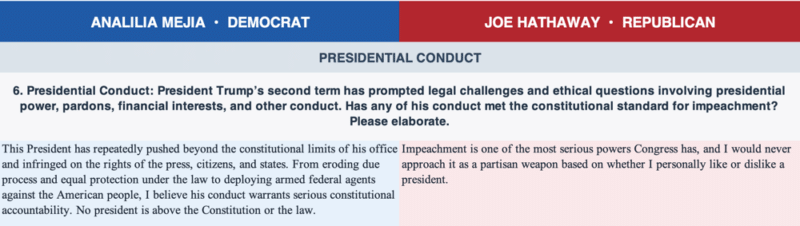
Asked whether any of President Trump’s second-term conduct had met the constitutional standard for impeachment, Mejia said he had “repeatedly pushed beyond the constitutional limits of his office” and that his conduct warranted “serious constitutional accountability.”
Hathaway wrote that impeachment is “one of the most serious powers Congress has” and should never be used as a partisan weapon. He did not identify any specific Trump conduct that he believed did or did not meet the constitutional standard.
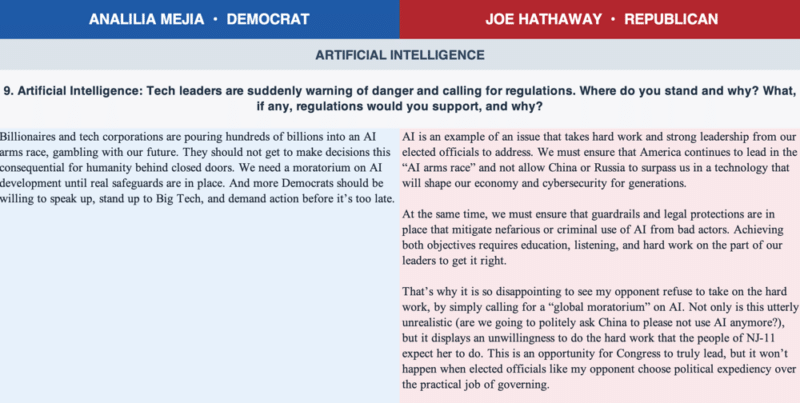
TWO VERY DIFFERENT APPROACHES TO AI
Artificial Intelligence produced another sharp split.
Mejia warned that “billionaires and tech corporations” are “gambling with our future” and called for “a moratorium on AI development until real safeguards are in place.”
Hathaway rejected that approach, saying the United States must remain ahead of China and Russia in the “AI arms race” while Congress establishes legal protections and guardrails against harmful uses.
He called Mejia’s proposed global moratorium “utterly unrealistic,” asking: “Are we going to politely ask China to please not use AI anymore?”
AND WHAT ABOUT POLITICAL INDEPENDENCE?
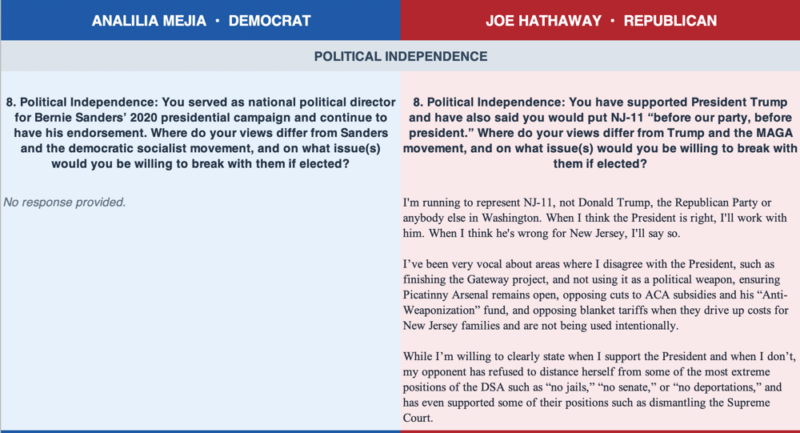
Each candidate received a separate question asking where they would break with the political figures and movements most closely associated with them.
Hathaway answered that he is “running to represent NJ-11, not Donald Trump, the Republican Party or anybody else in Washington.” He cited the Gateway project, Picatinny Arsenal, ACA subsidies and blanket tariffs as areas where he said he has disagreed with Trump.
Mejia left her corresponding question about Bernie Sanders and the democratic socialist movement unanswered.
WANT TO MEET THE CANDIDATES FOR YOURSELF
Voters will have several opportunities before Election Day.
Hathaway has a campaign town hall scheduled for Oct. 21 at the Rockaway Township Senior Center, from 7 to 8:30 p.m. Mejia’s campaign lists an Oct. 22meet-and-greet in Whippany at 6:30 p.m.
Their major joint appearance comes on Oct. 26 at 6:30 p.m., when Mejia and Hathaway are scheduled to debate at Saint Elizabeth University in Morristown. The nonpartisan event is being sponsored by the League of Women Voters of New Jersey, ACLU-NJ, New Jersey Hills Media Group and the Morristown Alumnae Chapter of Delta Sigma Theta Sorority, and a livestream is planned.
VOTING HAS BEGUN
Vote-by-mail ballots began going out last month. The deadline to register for the Nov. 3 general election is Oct. 13; in-person early voting runs Oct. 24 through Nov. 1. Election Day polls are open from 6 a.m. to 8 p.m.
MORE ON MEJIA-HATHAWAY 2026 CAMPAIGNS
Morristown has a long history of people stepping forward in pivotal moments.
When you chip in to Morristown Green, you’re helping your neighbors stay informed, strengthening our civic backbone, and carrying on the spirit that’s defined this town since its earliest days.
Rally for local news.