By Sophia Ricciardelli
We spend our lives inside institutions, from the office to the church pew to the voting booth, yet trust in them keeps declining. Few of those institutions carry more weight than the ones that govern us, and few have been tested for as long.
How did the founders build a republic that has lasted 250 years? And how can the institutions they created maintain public trust today?
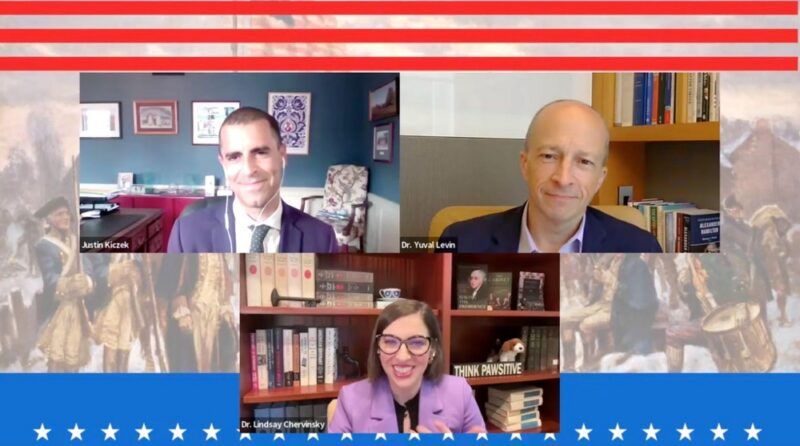
Scholars Yuval Levin and Lindsay Chervinsky took up those questions in the final installment of the F.M. Kirby Foundation’s We the People: Reflections at 250 webinar series, moderated by F.M. Kirby President Justin Kiczek.
Video replay: Trust & Institutions: Lessons from America’s First & Third Centuries:
‘A FLASH MOB IS NOT AN INSTITUTION’
Levin, the director of social, cultural and constitutional studies at the American Enterprise Institute, a prominent conservative think tank established in 1938, described institutions as “the durable forms of our common life.” Every institution, he said, is made up of a group of people, each with a distinct function and a shared purpose.
“The institution is the form that allows those roles to interact with each other and to pursue the goal they all have in common,” he said.
Levin separates those forms into “corporate” structures—think hospitals, universities, and companies—and those based mainly on norms—think cultural traditions, whole professions, or, most primitively, a family. “The family is the first and foremost institution of any society,” said Levin.
 In addition to following a form, Levin says institutions are durable, meaning they survive and evolve over a long period of time. “A flash mob,” he noted, “is not an institution.”
The institutions we are part of influence our behaviors and identities; they “turn us into a particular kind of person in the world,” Levin said, listing roles like father, husband, boss, employee, member of a religious congregation, or a civic organization.
He offered a simple example: He’s driving, and someone cuts him off. “I want to tell ‘em what I think about them, but my kids are in the car”—he’s in the role of “father.” “Given that, I’m going to behave differently.”
FIGURING OUT THE ‘FLESHY BITS’
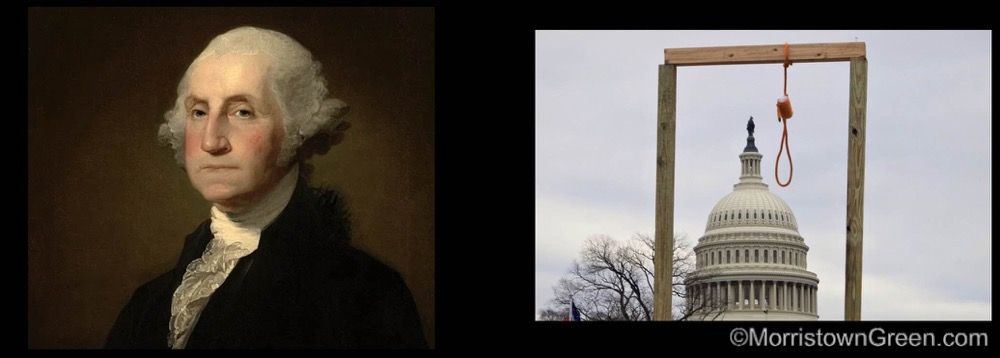
The U.S. government is an institution made up of institutions. The presidency, for example, is the central institution within the executive branch, one of three main institutions that make up the government as a whole. Political institutions have a formal structure of written law to guide members in their public-service duties. But in 1789, when George Washington became president, that written law—the newly ratified Constitution—was fairly vague.
When the Constitution was drafted, it ran just over 4,000 words, which is remarkably short. Article II, which establishes the presidency and the executive branch, assigns powers to the president but says little about what the office should actually look like in form and function.
Chervinsky, executive director of the George Washington Library at Mount Vernon, explained that much of what defines the presidency in practice, including how presidents conduct themselves, make decisions, deal with Congress and the courts, engage with the public, and represent the country abroad, rests on established norms and customs rather than Constitutional text.
“I often think of norms and customs sort of as the scaffolding around our political institutions,” she said. “They’re the things that hold it upright.”
The presidential matters that were unwritten and had to be figured out in real time, what Chervinsky calls the “fleshy bits,” of U.S. government, were up to Washington.
As Chervinsky explains, he was not blind to the pressure of the position. Before his inauguration, he wrote to a friend that he felt like the “criminal who is going to the place of his execution.” He knew how easily republics could fall, and he knew that they were lucky to get a second chance at all after the Articles of Confederation. He knew every decision required the utmost care because it would set the precedent for centuries to come.
“He genuinely worried that any misstep could be fatal,” Chervinsky said.
One of the main challenges for the founders was convincing the American people that this new government could work for them, and that a president was not a king.
“So much of Washington’s presidency was trying to imbue the institution with the respect and the trust that he already had from the American people,” said Chervinsky. “And the biggest way that he did that was by leaving.”
Washington could have remained president for life, and many expected him to. Instead, he declined a third term and peacefully passed on his power, proving that the new government was bigger than any one man. That was one of the main characteristics experts said made Washington such a great leader: He constantly thought about the strength of the institution as a whole and treated it as something that would outlive him.
Levin explains institutional leadership through an analogy of molds versus platforms. When we truly commit ourselves to an institution, we give up some of our individuality and personal desires in service of its purpose. As he puts it, “We take the shape that it needs us to take for the time that we’re operating within it.”
So, when we evaluate a leader like a president or a member of Congress, the question to ask is whether they are willing to be molded in the way that makes them most effective, or whether they see the role as “a platform for themselves to build a following, to build a personal brand.”
Washington, Levin says, is a great example of a mold. Rather than asking “What do I want to do with this power?” he asked, “What is a president, and how do I become one?” He had to pioneer that definition himself. Aaron Burr, by contrast, saw office as a platform, a place from which he could pursue his own ambitions more effectively.
Adams had a difficult task in succeeding Washington, who everyone knew and trusted. So he made himself a mold, too. “What Adams wanted was not the acclaim and power of the office, but the knowledge that the American people valued his service enough to call him to it,” said Chervinsky.
That meant following in Washington’s footsteps and making sure his values, like transparency and cooperation with Congress, became precedent rather than “interesting historical footnotes,” as Chervinsky puts it.
Perhaps his most selfless moment, Chervinsky notes, came in 1799, when he pursued peace with France. The decision fractured his own party and nearly guaranteed his defeat in the election of 1800, but he made it for the good of the nation.
‘WHAT’S MY ROLE HERE?’
Today, many Americans have lost trust in government and other institutions. Levin argues that one reason is that “Americans now haven’t really faced the kinds of existential crises of war in particular that have brought the country together in the past.” He points to the years after World War II, when trust in government and elites was exceptionally high.
Additionally, with the rise of social media, more and more people see the institutions they’re in as platforms for themselves, Levin says. Social media “gives us a sense that we’re all on display. We’re putting on a show rather than thinking of ourselves as existing inside of an institution and having a role to play within it,” he says.
That’s where Levin thinks much of our modern political frustration comes from. “A lot of the [politicians] who most drive us crazy just never seem to ask: ‘What’s my role here?'” he said. “They just ask: ‘What do I want to do?'”
The answer, both speakers argued, starts with ordinary citizens thinking institutionally. Whether you’re deciding who to vote for or taking part in civic life inside your own institutions, ask yourself the same question: “What’s my role here?”
No matter what party you belong to, Chervinsky said, “Being a patriotic American means wanting the country’s institutions to survive.”
“Institutions don’t exist by accident,” she said. They depend on our constant recommitment to them.
COVERAGE OF ‘WE THE PEOPLE: AMERICA AT 250’
Morristown has a long history of people stepping forward in pivotal moments.
When you chip in to Morristown Green, you’re helping your neighbors stay informed, strengthening our civic backbone, and carrying on the spirit that’s defined this town since its earliest days.
Rally for local news.