By Ellen S. Wilkowe
Retired FBI agent Bill Bolinder has no ordinary “remember when” moment from his time and place in history on 9/11. His mind is seared by a series of moments that catapulted him from his Brooklyn office to Ground Zero.
“One thing I will never forget is while we were walking across a section of Church and Murray Streets, there was a jet engine from one of the planes sitting on the sidewalk,” the former Morris Plains resident said. “There were people standing around talking about it and it was a completely surreal sight.”
Bolinder shared his gripping account Friday as keynote speaker at the borough’s memorial observance, marking the 25th anniversary of the Sept. 11, 2001, terror attacks.
He recalled how a normal Tuesday morning changed in a heartbeat, when a smoky sky indicated trouble. Terrorists hijacked and flew two planes into New York’s World Trade Center, the Pentagon and a field in Shanksville, PA, on that tragic morning.
Morgue duty: Former FBI agent recounts grim hours and days after the terror attacks:
The attacks claimed nearly 3,000 lives; 64 Morris County victims included one from Morris Plains, Eileen Marsha Greenstein, 52, who worked in the claims department at Aon in the World Trade Center.
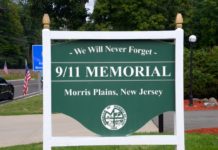
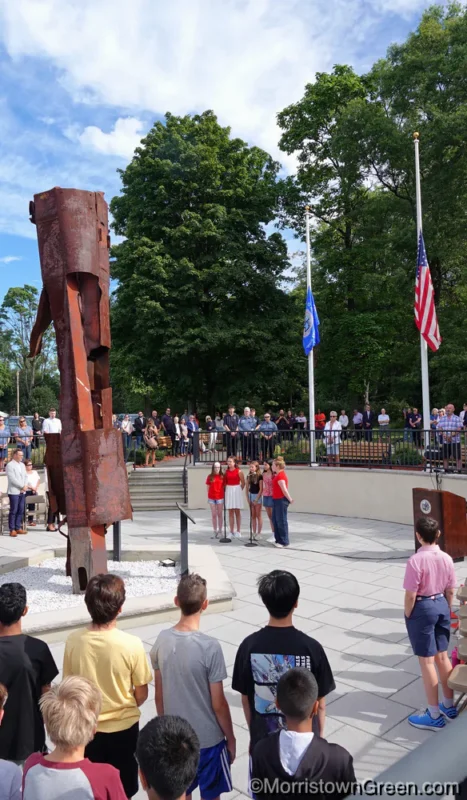
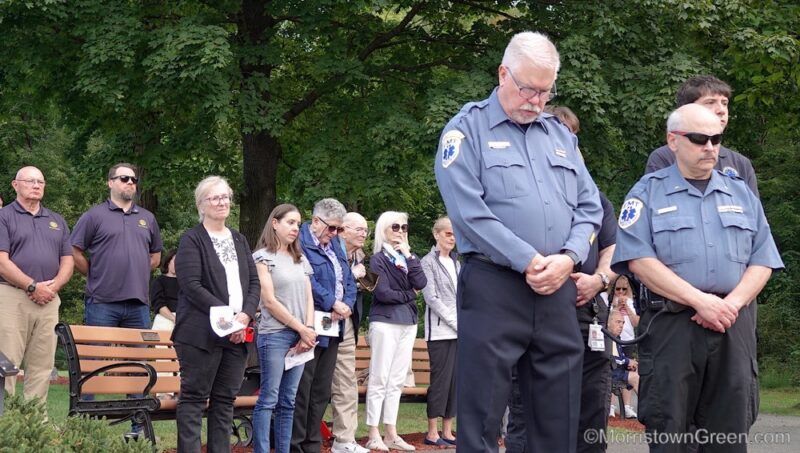
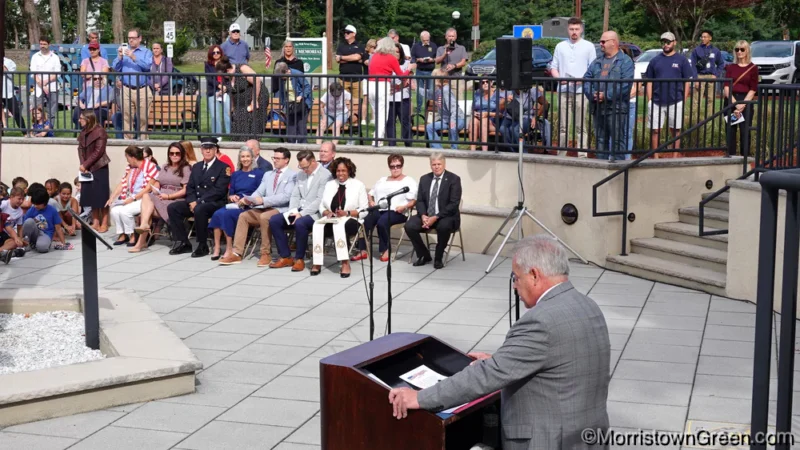
Hundreds attended Friday’s ceremony at the borough’s 9/11 Memorial Park, where Mayor Jason Karr emceed. The crowd included council members, the fire and police departments, veterans from Watnong VFW Post 3491, and Morris County Prosecutor Robert Carroll, among other dignitaries.
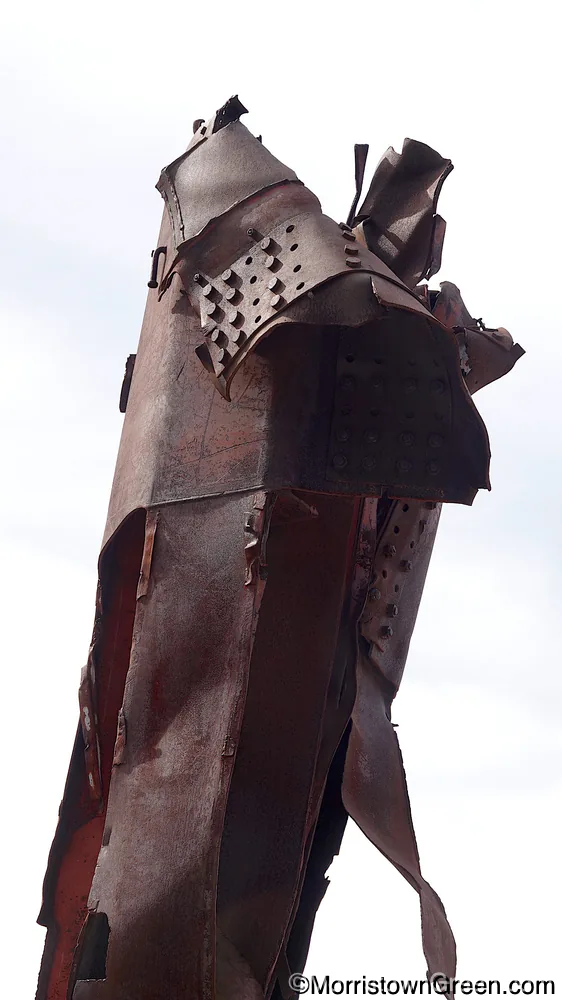
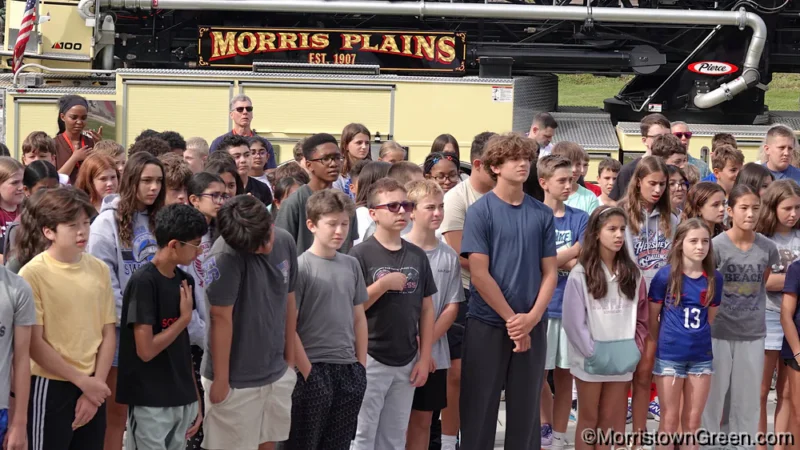
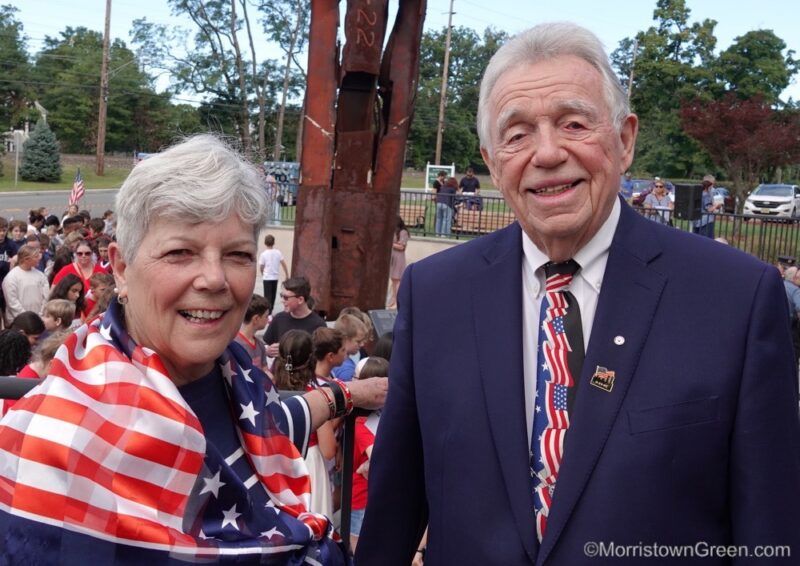
Representing post 9/11 generations were students in grades 5 through 8 from the Borough School, who listened beneath a charred steel beam from one of the Twin Towers.
The late-summer weather proved eerily similar to the bright sky of 9/11 — before it turned black at 8:46 a.m., when the first plane struck the North Tower. The second plane hit the South Tower at 9:03 a.m. A third plane breached the Pentagon at 9:37 a.m. and by 9:59 a.m. the South Tower had collapsed. Minutes later, a plane crashed into a field in Shanksville, Pa. followed by the collapse of the North Tower at 10:28 a.m.
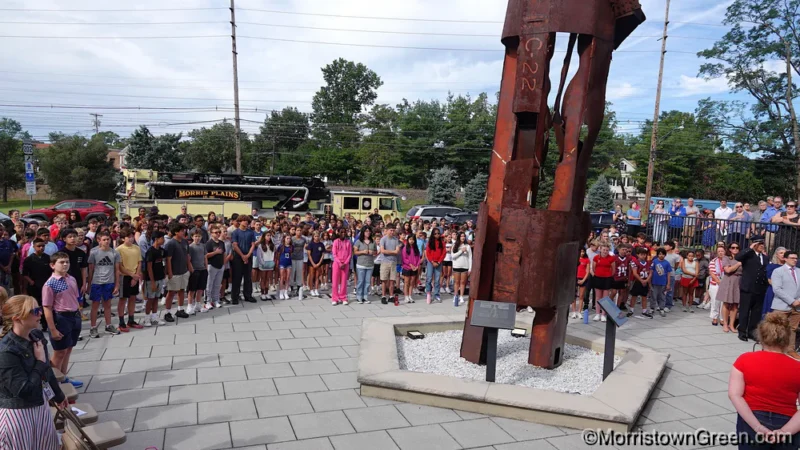
Morris Plains marked the times with siren blasts and moments of silence. At one point, a passenger train rumbled past.
Karr took note: “The sounds of everyday life like the trains, and planes flying overhead, ceased that day,” he told the students. “And if you looked to the east you would have seen black smoke.”
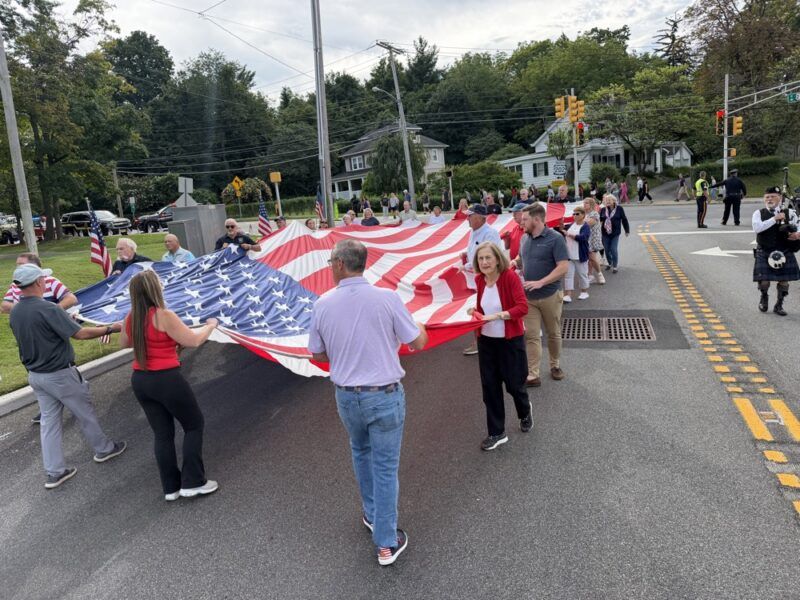
American flags lined Tabor Road leading to the memorial park. Student Charlie Geller wore an American flag shirt for his role as flag salutatorian. His salute followed the solemn raising of the flag to half-mast by first responders.
The Rev. Danielle Baker of St. Paul’s Episcopal Church spoke of a shared responsibility to look after for one another.
“Today we remember those who kissed their families, went to work and stepped unknowingly into history,” she said. “Today we hold space for grief, for courage and for countless acts of kindness that follow an unimaginable loss. May this time remind us of our shared responsibilities to protect one another and to nurture peace.”
Video: A minister recites a poem that tries to make sense of the incomprehensible:
‘IT BECAME COMPLETELY DARK’
Bolinder knows that responsibility well.
The Massachusetts native became a Morris Township police officer at age 19, and was a volunteer with the Morris Minutemen emergency rescue team, Karr said.
Bolinder entered the FBI Academy in 1990 and served until retiring in Morris County in 2015. He downplayed his painstaking role in helping identify victims and notifying next of kin.
“Just to be clear, the word hero belongs to the firemen and the cops who lost their lives, and those who conducted the actual rescue operations on that day,” he said. “I was merely a witness to their heroism.”
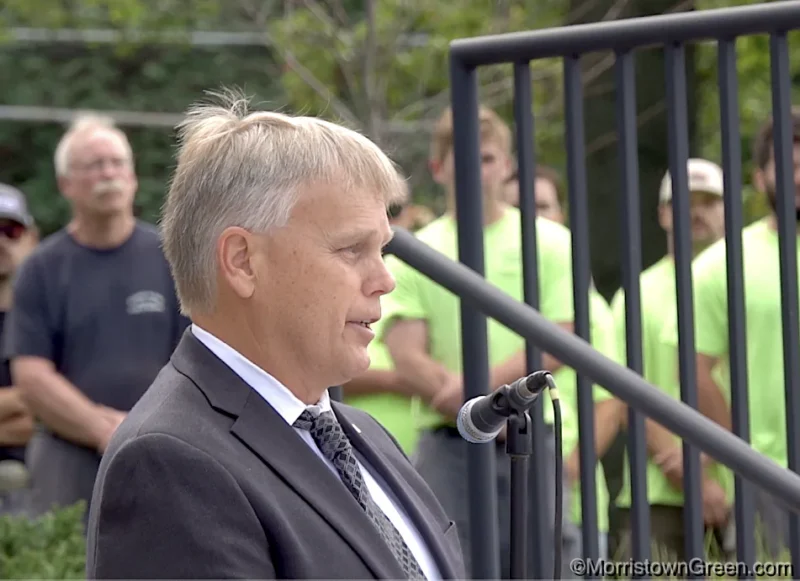
Like most Americans, Bolinder headed into work that Tuesday with a business-as-usual mindset. He was preparing to testify in a murder trial, and showed up at 7:30 a.m. to meet with the prosecutor.
“Ironicially, I happened to be wearing my best suit and tie,” he said.
As he made his way toward the federal courthouse in Brooklyn, he saw people pointing in the direction of Manhattan. “We looked up and saw some black smoke billowing, but trees in the park prevented us from seeing what was happening,” he said.
After learning about the first plane, he assumed it was a small Cessna. Then, “one of the guards at the courthouse yelled out that a second jetliner had just hit the second tower. At that moment there was no doubt in my mind that this was a terrorist attack and that our trial was not going to continue.”
Instincts and adrenaline kicked in: He was going to Manhattan to help. Heading to his car, he was asked by the chief of the terrorism unit from the U.S. Attorney’s Office for a ride to the FBI building in Manhattan.
At the entrance to the Brooklyn Bridge, an NYPD sergeant asked if a couple of his guys could hitch a ride, too; reinforcements were needed for crowd control on the Manhattan side of the bridge.
They inched across the bridge in silence, taking in a massive crowd walking straight toward them.
“When we approached the center span of the bridge, I could see just how bad the devastation really was,” he said. “There was a stream of fluttering paper flowing across the blue sky.”
Bolinder was tasked with setting up a crime scene around the Trade Center.
“There were rumors that more planes were up in the air and possibly heading for New York City,” he said. ”For the rest of the day we kept looking up in the sky wondering if there would be more incoming planes.”
Ten minutes after arriving at his destination, he heard a boom he likened to the sound of a “truck loading a dumpster onto it” — only 10 times louder.
“At the same time, we saw people running toward us with the largest black rolling cloud of smoke behind them, all headed our way… We turned around, ran about a block and ducked into the lobby of a building. As the cloud went by, it became completely dark outside and we waited for what seemed like an eternity.”
After the sun returned, Bolinder was directed to Church Street by fire personnel and then the second boom hit. “At that point, the North Tower was collapsing and we just stood there,” he said. “There was so much dust and smoke.”
VICTIM NUMBER ONE
Returning to the command post, he walked into complete chaos. The air had been declared unsafe and the post was relocated to the U.S.S. Intrepid, a World War II aircraft carrier-turned-museum, on the Hudson River near 46th street.
With the assistance of the FBI chaplain, he was then tasked with responding to several temporary morgues being set up near the towers. “I had a list of agents who had not yet reported in, as well as FBI employees who were unaccounted for,” he said. “We had to check the morgue sites and begin to notify family members.”
One site was at St. Peter’s Episcopal Church on Broadway. “When we entered the church, we saw Father Mychal Judge, laid out upon the altar,” he said.
Judge, the New York Fire Department chaplain, would become known as “Victim Number One,” he said.
“The FBI chaplain had dinner with him just a few nights before,” he said. “He kind of broke down.”
After returning to the Intrepid, he received orders to return home, rest and report back the next morning. Instead, he assigned himself to the bucket brigade. “It was a human chain that moved buckets of debris away from the (Tower) sites where rescue teams were searching and digging,” he said.
When Bolinder finally approached the tunnel to return to Morris Plains, a Port Authority truck operator hosed down his car to reduce dust contamination within the tunnel. The carwash would become a nightly ritual for the next few weeks.
Exhausted, “filthy” and covered in dust, Bolinder got home in the early hours of Sept. 12, staying just long enough to get cleaned up, kiss his sleeping family and head back out for his next grueling assignment: Assisting with victim identification using DNA.
He was stationed at a makeshift morgue near Bellevue Hospital, where tents and tables were set up in the parking lot.
“A refrigerator truck would arrive every few hours with more victims,” he said.
For the next few weeks, working from 6 a.m. to 6 p.m., Bolinder continued to assist in victim identification. “At the end of each shift, we would head back down to join the bucket brigade, and then return home for a few hours of sleep.”
The refrigerated trucks came frequently at first.
“We’d suit up, mask up and mentally prepare for what was coming” each day, he said. “By the second week, things slowed down to a trickle and we just watched the clock until the shift ended so we could go down to the piles.”
After the second week, the funerals began, as did a new assignment. This time, he was deployed to Fresh Kills Landfill on Staten Island, where debris from the rubble at Ground Zero was loaded off the dump trucks.
“We had to clear each pile from the dump trucks and sift through the debris, looking for remains and evidence like pieces of a plane,” he said. “It was hard work and we were initially using shovels and pitch forks. But after a week our evidence response team set up sifting machines on a conveyor belt.”
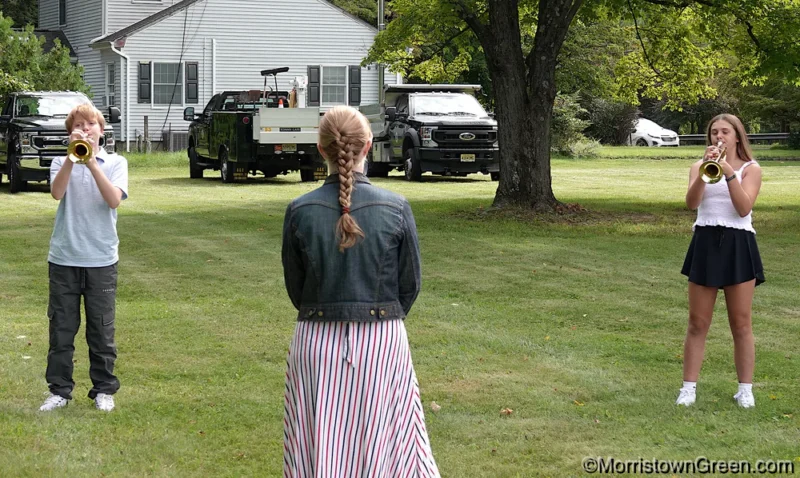
Kaitlin Michalowski looks on, Morris Plains, Sept. 11, 2026. Photo by Kevin Coughlin
“FEED THE FEDS’
Bolinder later returned to the Intrepid to investigate how the remains were related to the attacks.
“This would continue up until 2002, and slowly we began to return to our regular investigations,” he said. “These were truly sad times, but there was always hope in the air. Every day when we headed downtown there were tons of people on the side of the road cheering and shouting as we passed.”
The sheer volume of donated food led to jokes about weight gain. “There was a truck that came by every night with a sign that read “Feed the feds,” he said.
The outpouring of support spilled over into communities including Morris Plains, which lived up to its “Community of Caring” slogan.
“The days that I was home I would see American flags everywhere– on cars, and windows,” he said.
“People were just generally being nice to each other. It didn’t matter whether you were Democrat or Republican. We were all Americans healing and rebuilding together.”
If there’s one thing he misses from that tragic time, it is that.
“I think over time that we kind of lost that sense of optimism and in some ways, I kind of long for that feeling of unity,” he said. “I hope someday we will get it back.”
After Borough School students recited poems and essays, trumpeted Taps and sang God Bless America, Mayor Karr sent them home with an assignment:
“Go be with your loved ones,” he instructed, “and perform acts of kindness.”
Video: Middle school students try to imagine what 9/11 was like:
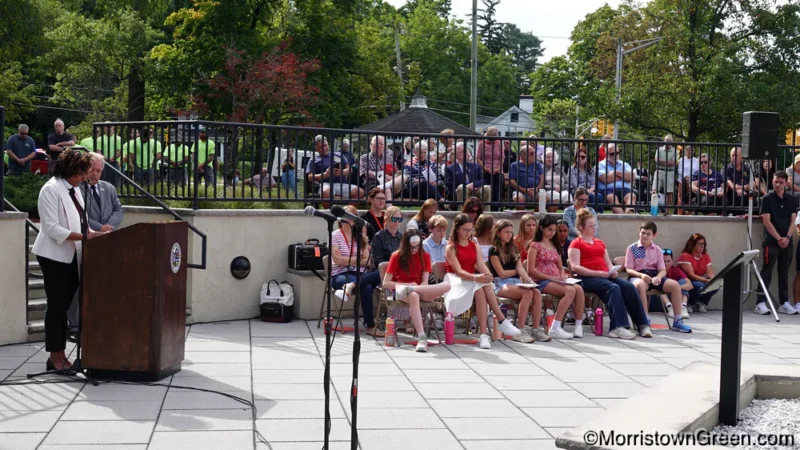
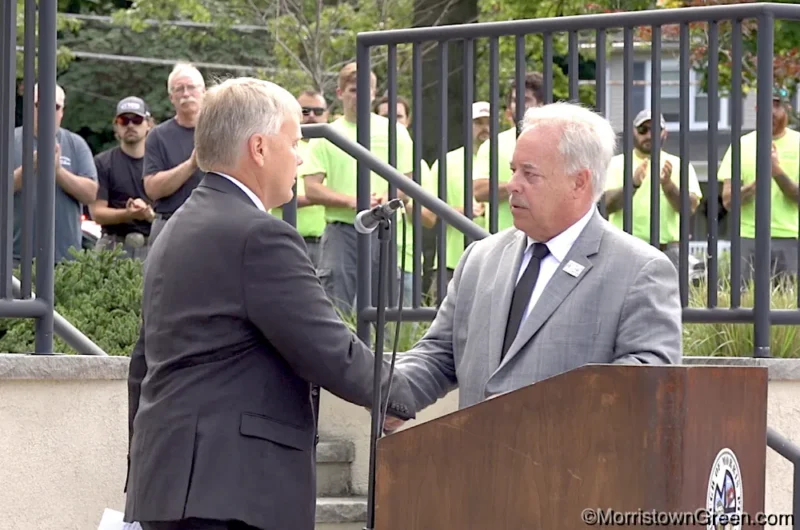
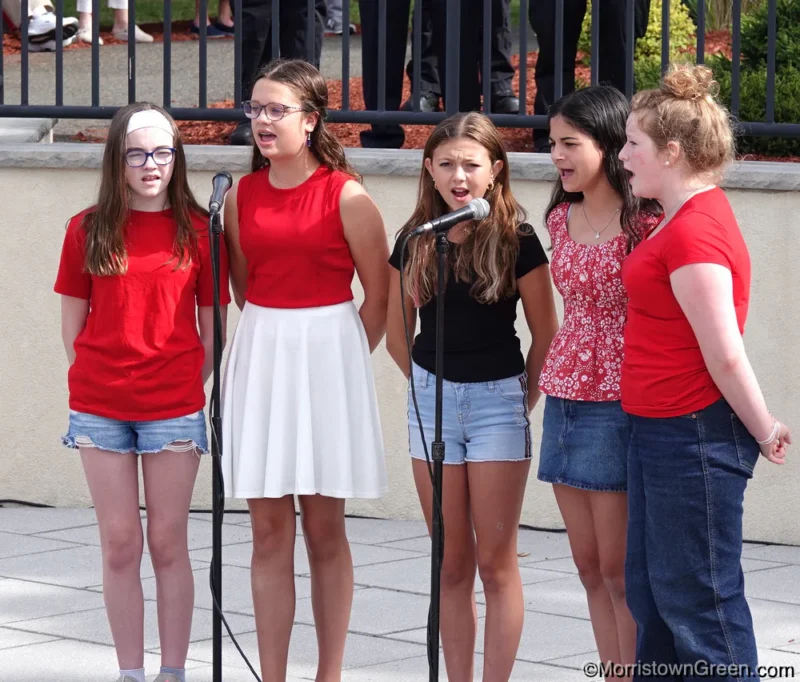
Morris Plains, Sept. 11, 2026. Photo by Kevin Coughlin
Morristown has a long history of people stepping forward in pivotal moments.
When you chip in to Morristown Green, you’re helping your neighbors stay informed, strengthening our civic backbone, and carrying on the spirit that’s defined this town since its earliest days.
Rally for local news.