By April Stelle
IF WE WIN THE GAME: What is the path to the World Cup?
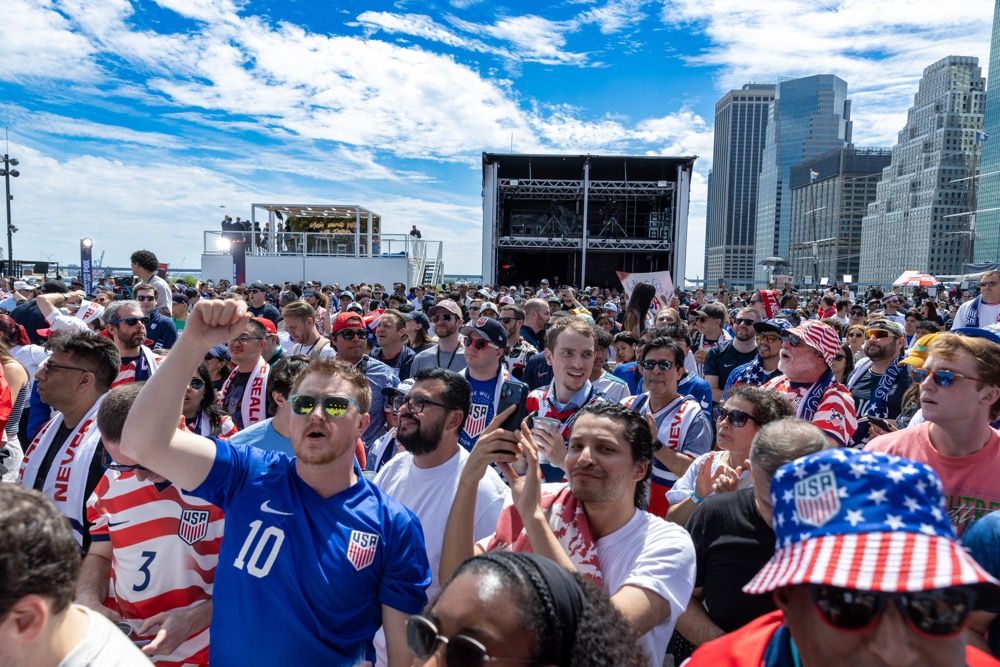
Wednesday, July 1, 2025: The U.S. men’s national team will face Bosnia and Herzegovina, an independent country on the Balkan Peninsula in southeastern Europe, in its first knockout match. The game is at 8 p.m. at Levi’s Stadium in Santa Clara, Calif. It will air in English on Fox and stream on Hulu, YouTube TV and Fubo, and in Spanish on Telemundo and Universo, streaming on Peacock.
To get here, the Red White and Blue clinched Group D by defeating Paraguay 2-1, and Australia, 2-0. The team lost to Türkiye, 3-2.
If the U.S. defeats Bosnia and Herzegovina as expected, it will face either Belgium or Senegal in the Round of 16.
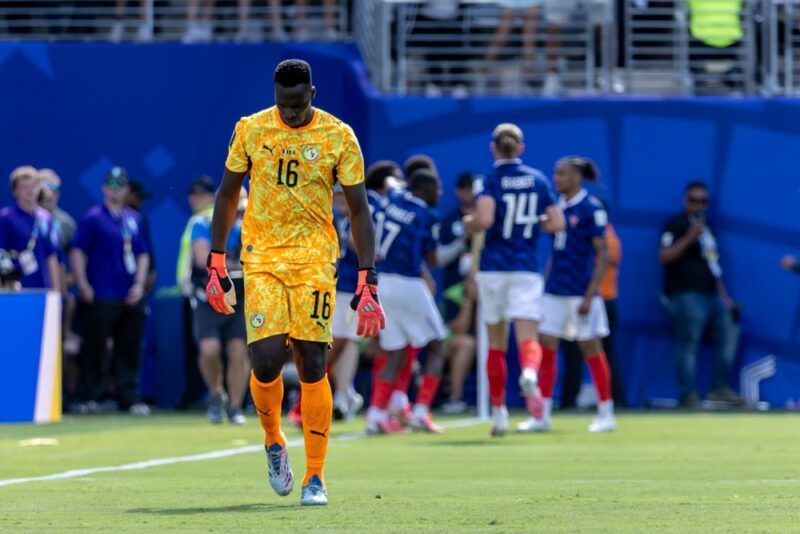
Belgium finished first in Group G after draws with Egypt and Iran and a 5-1 victory over New Zealand. Senegal finished third in Group I, one of the tournament’s toughest groups. It lost to France and Norway but routed Iraq 5-0 to clinch a knockout berth. Belgium and Senegal meet Wednesday at 4 p.m. in Seattle.
WHAT IS THE KNOCKOUT ROUND? Do they duke it out?
The knockout round is exactly what it sounds like: Lose, and you’re out.
In the first-ever Round of 32, FIFA placed the 12 remaining first- and second-place teams, along with the eight best third-place teams, into a predetermined bracket. Group winners were rewarded with matchups against third-place teams whenever possible, although some — including Brazil, the Netherlands and Portugal — drew second-place opponents.
Except for the third-place match between the semifinal losers, every game is win-or-go-home.
If a match is tied after 90 minutes, it goes to 30 minutes of extra time, divided into two 15-minute halves with a hydration break.
The “Golden Goal” rule used in the 1998 and 2002 World Cups — in which the first team to score in extra time won immediately — has long since been abandoned. Teams now play the full 30 minutes.
If the score is still tied, the game goes to a penalty shootout.
Each team takes five penalty kicks from 12 yards out. If one team builds an insurmountable lead before all five kicks are taken, the shootout ends early. If the teams remain tied after five kicks each, the shootout continues one kick at a time in sudden death until one team scores and the other misses.
A coin toss determines which team shoots first.
Only the 11 players on the field at the end of extra time may participate. Every player, including the goalkeeper, must take a kick before anyone shoots a second time. If a shootout appears likely, managers sometimes use late substitutions to bring stronger penalty takers onto the field.
Monday’s games produced two stunning upsets. Germany and the Netherlands were eliminated by Paraguay and Morocco, respectively, after penalty shootouts, despite entering the tournament as favorites.
WHO ARE THE FAVORITES SO FAR?
France has looked dominant in the group stage behind star forwards Kylian Mbappé, presently tied for most goals with six, and Ousmane Dembélé.
Argentina appears well positioned to defend its title, with Lionel Messi tied for the tournament lead in goals.

Spain rebounded nicely after its opening draw with Cape Verde to finish atop its group, while England also looks dangerous behind striker Harry Kane.
WHO ARE THE SURPRISE TEAMS?
Cape Verde stunned the soccer world by holding Spain to a scoreless draw in its first-ever World Cup match.
Its 40-year-old goalkeeper, Josimar José Évora Dias — better known as Vozinha — made seven saves and became an overnight social media sensation. His following exploded from about 56,000 to 13.8 million after the match and has since grown to 17.4 million, surpassing even Tom Brady’s 15.5 million followers.
Cape Verde followed with draws against Uruguay and Saudi Arabia to reach the knockout round. Its run may end Friday, however, when it faces Argentina at 6 p.m.
Canada also made history Sunday, winning its first-ever World Cup knockout game on a dramatic last-minute goal against South Africa. It will face Morocco on Saturday at 6 p.m.
WHAT TEAMS ARE ELIMINATED?
Group-stage eliminations:
Korea, Czech Republic, Qatar, Scotland, Haiti, Turkey, Curaçao, Tunisia, Iran, New Zealand, Uruguay, Saudi Arabia, Iraq, Jordan, Uzbekistan and Panama.
Second-place team knocked out: Ivory Coast
Third-place teams that advanced to the knockout round:
- Congo DR
- Sweden — knocked out
- Ghana
- Ecuador — knocked out
- Bosnia and Herzegovina
- Algeria
- Paraguay
- Senegal
South Africa, Japan, Germany and the Netherlands were eliminated in the opening Round of 32 matches.
WHAT ARE VEGAS ODDS FOR THE U.S. WINNING THE CUP?
As of Monday, FanDuel Sportsbook listed the U.S. men’s national team at +3500 to win the World Cup — or about 35-1. A $10 bet would return $360, including the original stake.
WHAT IS OFFSIDE? Does anyone know? What the heck is VAR?
Scoring goals means getting behind defenders, which is made more complicated by one of soccer’s trickiest rules: offside.
Simply put, a player is offside if any part of the body that can legally score a goal is beyond the second-to-last defender when a teammate plays the ball forward. If the player is level with the defender, there’s no offside. The rule does not apply on corner kicks, goal kicks or throw-ins.
Does this video help?
Video assistant referees, or VAR, monitor every match from the Video Operations Room (VOR) at the International Broadcast Centre in Dallas. Assisted by additional VAR officials, they review every potential goal, penalty, red card and mistaken identity to determine whether the referee made a “clear and obvious error” or missed a serious incident.
VAR may recommend an on-field review, but the referee always has the final decision. There is no time limit on reviews, and referees conduct them publicly for transparency.
This World Cup also uses Advanced Semi-Automated Offside Technology (SAOT). Sixteen stadium cameras track the ball and every player’s limbs in real time. When a player is offside, the system automatically alerts the VAR, speeding up decisions.
VAR already has generated plenty of controversy.
The biggest debate came in Germany’s loss to Paraguay. Germany appeared to score the winner in extra time, but after an on-field review the referee ruled defender Waldemar Anton had illegally blocked Paraguay’s goalkeeper. The goal was wiped out, Germany failed to score again and was eliminated in a penalty shootout, prompting fierce debate over whether enough contact occurred to justify the foul.
HOW DO SUBSTITUTIONS WORK?
During the group stage, each team was allowed five substitutions over three substitution windows. Halftime changes do not count toward those windows, and if both teams substitute at the same stoppage, it counts as a window for each. Once a player leaves the match, that player cannot return.
Because knockout games can go to extra time, each team receives one additional substitute and one additional substitution window. Changes made before extra time begins or during the halftime break in extra time do not count against that total.
WHAT IS STOPPAGE TIME? Does anybody really know what time it is?
Soccer keeps time differently from most American sports.
Instead of stopping the clock for injuries, substitutions and other delays, the referee keeps track of lost time and adds it to the end of each half.
Written as 90+2, for example, the added time is only the minimum. More can be added if additional delays occur during stoppage time.
Lengthy stoppage times became a major talking point during the 2023 Women’s World Cup, when matches routinely stretched beyond 100 minutes.
To reduce time-wasting, FIFA introduced several new rules for 2026.
Goalkeepers and players taking throw-ins now face a visible five-second countdown. If they exceed the limit, a throw-in is awarded to the opposing team or a delayed goal kick becomes a corner kick.
Substituted players now have 10 seconds to leave the field. If they don’t, their team must temporarily play short-handed until the next stoppage.
Players treated by medical staff generally must remain off the field for one minute before returning. Exceptions include injured goalkeepers, collisions involving goalkeepers, serious injuries such as concussions, players fouled by an opponent who is sent off, and players expected to take a penalty kick.
FIFA also cracked down on the old “goalkeeper tactical timeout,” in which a keeper feigned injury so teammates could gather around the coach for instructions. Teams are now prohibited from going to the bench during goalkeeper injury stoppages.
WHAT ARE THE POSITIONS ON A SOCCER TEAM? Can anyone score?
There are four basic positions: Forwards, midfielders, defenders and the goalkeeper.
Forwards are primarily responsible for scoring. Midfielders link the offense and defense, defenders protect their own goal, and the goalkeeper is the last line of defense.
And yes — anyone on the field, including defenders and goalkeepers, can score.
WHAT ARE TYPICAL FORMATIONS?
Formations vary by opponent, game situation and coaching philosophy.
The most common are 4-3-3 and 4-2-3-1. The U.S. has alternated between those two formations depending on the matchup.
DOES IT HURT TO HEAD THE BALL? Why aren’t there more concussions?
Heading the ball can hurt, especially on hard clearances or powerful crosses, but players are trained to strike it with the forehead, the strongest part of the skull.
Researchers continue to study the long-term effects of repeated heading, and many youth leagues now limit or prohibit it for younger players.
At the professional level, concussions do occur but are less common than many fans might expect because players are taught proper technique and officials now follow stricter concussion protocols.
HOW MANY BILLIONAIRES ARE PLAYING IN THIS TOURNAMENT?
Two billionaires are on the pitch this year: Cristiano Ronaldo and Lionel Messi.
With an estimated $300 million in earnings over the past year, Ronaldo remains the world’s highest-paid soccer player and one of only four professional athletes to reach billionaire status, according to Forbes. His estimated net worth is about $1.2 billion.
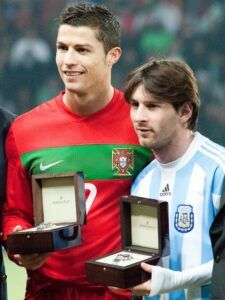
Photo by Fanny Schertzer
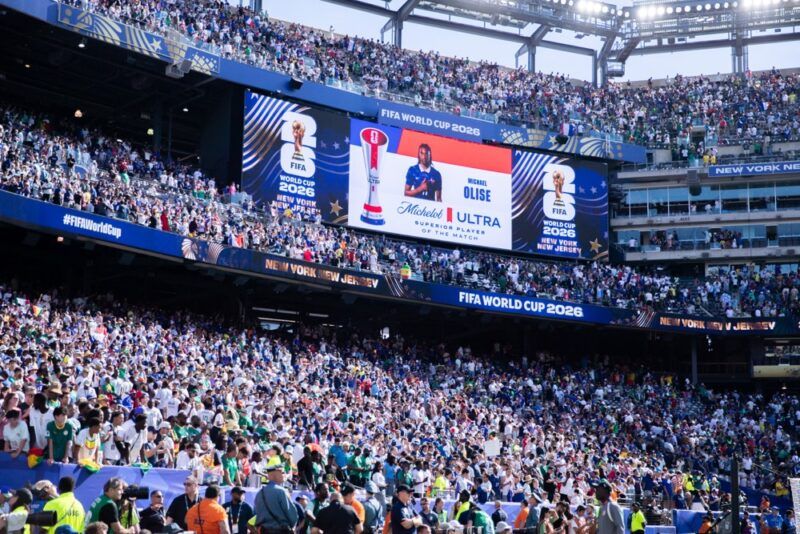
Messi joined Forbes’ billionaire list this year with an estimated net worth of $1.1 billion. His roughly $140 million in annual earnings are split evenly between on-field salary and endorsements. He appears in advertising campaigns for Adidas and Michelob Ultra alongside celebrities including Bad Bunny, Timothée Chalamet and U.S. soccer star Christian Pulisic.
If you’re looking for a souvenir, Lowe’s is even selling a 10-foot inflatable Messi for $99.
Four of the tournament’s five highest-paid players also rank among its leading goal scorers. The exception is Ronaldo. France’s Kylian Mbappé ranks third in earnings at $95 million, followed by Norway’s Erling Haaland at $80 million and Brazil’s Vinícius Júnior at $60 million.
WHAT’S A FREE KICK? How expensive are the other ones? And yellow cards and red cards…what’s up with all the bumping and grabbing? Is this ball hockey?
Soccer penalties fall into two categories: fouls and misconduct.
A foul is an illegal action against an opponent that results in either a free kick or, if it occurs inside the defending team’s penalty area, a penalty kick. Law 12 of the Laws of the Game defines all fouls.
There are two kinds of free kicks:
- Direct free kicks allow the kicker to score without another player touching the ball. If the foul occurs inside the penalty area, the direct free kick becomes a penalty kick.
- Indirect free kicks cover less common violations, such as dangerous play or impeding an opponent without contact. Another player must touch the ball before a goal can be scored.
Misconduct is punished with yellow or red cards.
A yellow card is an official warning. Two yellow cards in the same match automatically become a red card.
A red card sends a player off immediately. The player cannot return or be replaced, leaving the team short-handed for the rest of the match, and is suspended for the next tournament game.
Serious foul play, violent conduct and several other offenses can result in a straight red card without a prior caution.
Yellow cards accumulate during the tournament, although totals reset after the group stage. They continue through the knockout rounds until the quarterfinals.
This World Cup also introduced two new red-card offenses: Covering your mouth to conceal comments directed at opponents or officials, and deliberately leaving the field in protest of a referee’s decision.
Paraguay midfielder Miguel Almirón learned that the hard way. He received a red card for covering his mouth during a match against Türkiye and was suspended for Paraguay’s next group-stage game against Australia.
Set pieces are any restarts after play has stopped, including kickoffs, free kicks, throw-ins, corner kicks and goal kicks.
Corner kicks are among soccer’s best scoring opportunities. Awarded when the defending team last touches the ball before it crosses its own goal line, they often send both teams crowding the penalty area in anticipation of a header or rebound.
A goal kick is awarded when the attacking team is the last to touch the ball before it crosses the defending team’s goal line.
UPDATE: This story has been updated to note the elimination of Sweden, Ecuador and Ivory Coast, and Kylian Mbappé tying Lionel Messi for most goals so far.
Morristown has a long history of people stepping forward in pivotal moments.
When you chip in to Morristown Green, you’re helping your neighbors stay informed, strengthening our civic backbone, and carrying on the spirit that’s defined this town since its earliest days.
Rally for local news.